
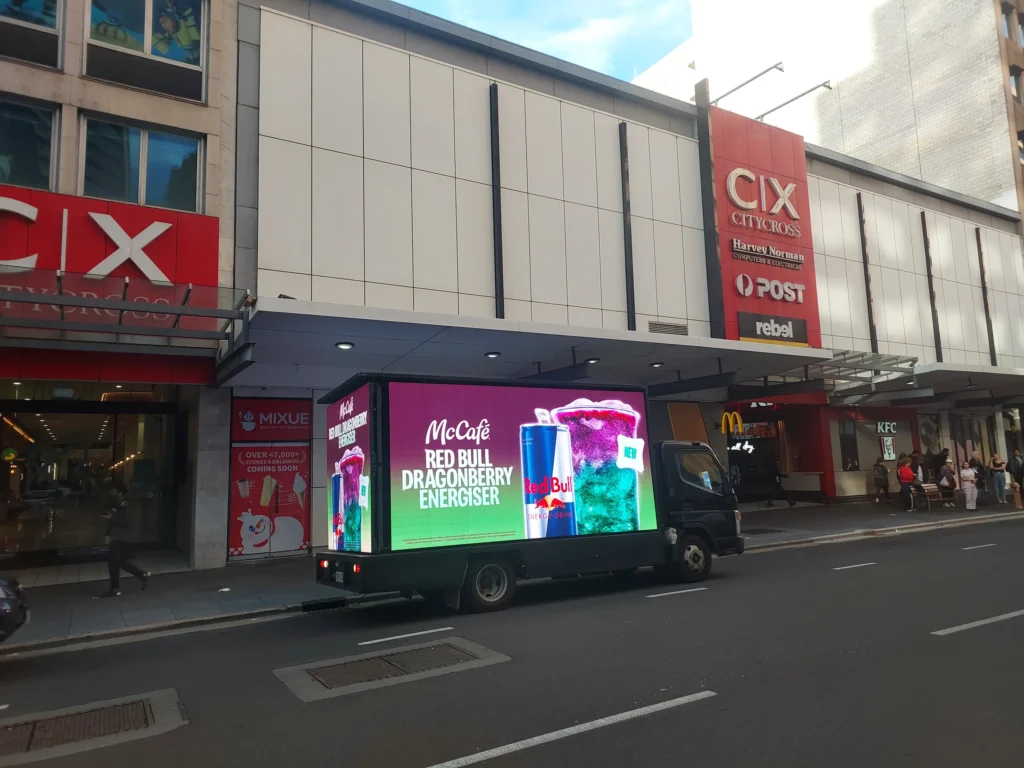
Hiring a digital advertising truck costs roughly $1,000 – $3,000 a day, while a solar LED trailer runs $600 to $1,500, with route, hours and campaign length setting the final rate. Demand keeps prices firm: digital formats claimed 77.1 per cent of out-of-home revenue in the OMA’s Q2 2026 results.
Those bands cover a full operated campaign day, not a bare vehicle, which is why comparing mobile rates against fixed billboard rents misleads more buyers than it helps.
Want a firm number instead of a band? Call Mick at Moving Media direct on 0417 848 150 for a free, no-obligation quote.
How Much Does It Cost to Hire a Digital Advertising Truck?
A digital advertising truck costs between $1,000 – $3,000 a day to hire, with three-sided LED units on busy metro routes sitting at the top of that band. Spread across the standard eight-hour broadcast day, that works out to roughly $175 to $440 for every hour your screens are live on the road.
That hourly lens is the honest way to judge the spend. The screen follows your audience through an entire working day, and the rate covers the whole operation rather than media space alone.
A single day works hard for that money. A typical brief runs the truck through commuter corridors in the morning, shopping precincts and lunch strips through the middle of the day, then an event pick-up or entertainment strip in the evening, with the route adjusting in real time as audience zones shift. That is a full working day of exposure for less than many fixed sites charge to stand still.
Screen spec moves the number more than anything else. A truck running three high-brightness LED faces with live streaming, audio and more than 12 screen modes carries a higher rate than a single-screen unit, because it reaches traffic from every angle at once.
What Does LED Trailer Hire Cost in Australia?
LED trailer hire in Australia sits between $600 and $1,500 a day for a solar-powered unit, or roughly $75 to $190 per broadcast hour. The trailer parks at a fixed high-traffic position, runs on sunlight day and night, and holds a single site the way a fixed billboard would, at a fraction of a four-week commitment.
Our solar LED trailer hire suits corner positions, event entrances and regional main streets where a full truck route would be wasted.
The trailer also wins on single-location briefs. When the objective is one intersection, one store opening or one showground gate, paying a truck to drive past repeatedly costs more than parking a screen there all day, and the trailer holds that ground for a fraction of the truck’s rate.
Printed billboard trailers cost less again because there is no screen to power. Those rates, along with fixed-site pricing, sit in our 2026 billboard pricing guide by location and size.
What Do You Get for the Day Rate?
The day rate buys a fully operated campaign, not a parked vehicle: the truck or trailer, the route or position, an eight-hour broadcast day with your content running 100 per cent of the time, and live campaign data. Nothing switches off between suburbs and nothing rotates your creativity out for another brand.
Every campaign starts with a consultation on goals, audience and time-of-day targeting, then we build the route and message schedule, often down to the hour. Content loads as a file, so there are no printing or installation charges on the digital formats.
Tracking comes standard as well. All campaigns include campaign data and reporting through Mobilytics™: live audience tracking, impression counts, heat maps and a post-campaign report, with retargeting options on top.
The whole job also sits with one supplier. Consultation, creative, logistics, data reporting and post-campaign retargeting are handled in-house, so one quote and one invoice cover the campaign end to end rather than three vendors billing separately.
One warning when you compare quotes elsewhere: ask whether the screens run the full day or on a shared rotation, and whether reporting costs extra. A cheaper headline rate with half the screen time is the dearer buy.
Digital Truck, Solar LED Trailer or Billboard Trailer: Which Fits Your Budget?
Match the format to the job before you match it to the budget, because each one buys a different kind of exposure per dollar. Day rates alone hide that difference, since an eight-hour operated truck and a parked screen are not the same product at the same price. The table below is how we frame it with advertisers, using cost per broadcast hour rather than the usual day rate alone.
| Format | Typical day rate | Cost per broadcast hour | Display and creative | How it works | Best suited to |
| Digital advertising truck | $1,000 – $3,000 | About $175 – $440 | Three-sided LED, full motion, audio, live streaming, 12+ screen modes | Driven along a planned route, or parked in event and corner activation modes | Product launches, festivals, multi-suburb campaigns |
| Solar LED trailer | $600 – $1,500 | About $75 – $190 | Single LED screen, full motion, sun-powered day and night | Positioned at one high-traffic location and left to broadcast | Store openings, event entrances, regional towns |
| Printed billboard trailer | Lowest entry cost | Lowest per hour | One printed skin per campaign | Towed to a position or route with a fixed message | Budget local campaigns and long static messages |
Trailer rates for the printed format, and how they stack up against fixed sites, are covered in the pricing guide linked above rather than repeated here.
What Pushes the Hire Price Up or Down?
Five levers move a mobile campaign quote more than any rate card. Hours come first: the standard day is eight broadcast hours, and extending into a longer day lifts the price in step. Route comes second, since CBD-heavy metro runs cost more to operate than regional routes.
An evening finish is the common case: a campaign that needs to hold a stadium exit or a late trading strip past the standard window simply prices in the added hours up front.
Campaign length works in your favour. We offer pricing tiers and genuine discounts for long-term bookings and multi-asset campaigns, so a fortnight costs meaningfully less per day than a one-off.
Creative and technology extras are the fourth lever. Custom creative builds, added tech features or special activation logistics can add to the quote, and we scope every one of them clearly before sign-off, so the number you approve is the number you pay.
The last lever is activation mode. Switching a truck into panoramic event mode or a multi-direction corner activation changes the operating plan, and the quote reflects the setup involved.
Why Do Advertisers Hire Moving Media’s Trucks and Trailers?
Advertisers hire Moving Media because more than 25 years of mobile out-of-home experience sits behind every quote, and the founder answers the phone. Mick Diffey scopes your campaign personally, and our mobile digital billboard services cover every Australian capital plus regional and remote areas, with partners across NZ, the UK, Europe and North America.
The same fleet serves advertising agencies, national brands, event organisers, government bodies and local business owners, so the operating playbook behind your quote has already run at every scale.
The spend keeps flowing into the channel for a reason. World Out of Home figures reported by B&T forecast global outdoor spending to grow from AU$77.9 billion in 2025 to AU$81.06 billion in 2026, and mobile formats let you buy into that momentum by the day instead of the month.
Every campaign also runs 100 per cent carbon neutral through our Reforest partnership, planting native trees to offset emissions, which no standard billboard contract includes.
What Do Advertisers Ask Before Hiring a Digital Truck or LED Trailer?
Advertisers ask five things before hiring: how many hours the rate covers, whether a driver is included, what mid-campaign changes cost, how far ahead to book, and why trailers cost less than trucks. The answers below settle each one.
How many hours of screen time does the day rate cover?
The day rate covers a standard eight-hour broadcast day, and your content runs for 100 per cent of that time with no gaps and no shared rotation. Scheduling is built around your audience, often down to the hour, so the screens work school runs, commutes or event peaks as your brief demands.
Is a driver included when you hire an advertising truck?
Yes, every truck campaign runs as a full service. We handle the vehicle, the route, the logistics and the on-road operation from start to finish, so you never supply a driver, fuel or insurance. Your side of the job is brief and creative; the road work belongs to us.
Does it cost extra to change your creative mid-campaign?
No, updating your content mid-campaign costs nothing extra, because creative loads as a digital file and can be optimised in real time while the truck is on the road. Fully custom creative builds or added tech features are the exception, and we scope those clearly in the quote before sign-off.
How far ahead should you book a truck or trailer?
Book two to four weeks ahead for a standard campaign, and earlier for the pre-Christmas rush, election periods or major event weekends when fleets across the country tighten. Shorter notice can still work on flexible dates, so call with your brief and we will confirm live availability the same day.
Why do solar LED trailers cost less than digital trucks?
A solar LED trailer runs one screen from a fixed position on free solar power, while a digital truck operates three screens along a driven route for a full broadcast day. Fewer screens and no road operation mean a lower rate, yet the trailer still broadcasts full-motion content day and night.
How Do You Get an Exact Price for Your Campaign?
You get an exact price by sending your dates, target areas and campaign goal to our team for a free consultation and a no-obligation quote, scoped clearly before sign-off. Bands like the ones above get your budget in the right postcode; a scoped quote gets it to the door.
Call Mick directly on 0417 848 150 or plan your campaign online, and Moving Media will put real numbers against your brief.
