
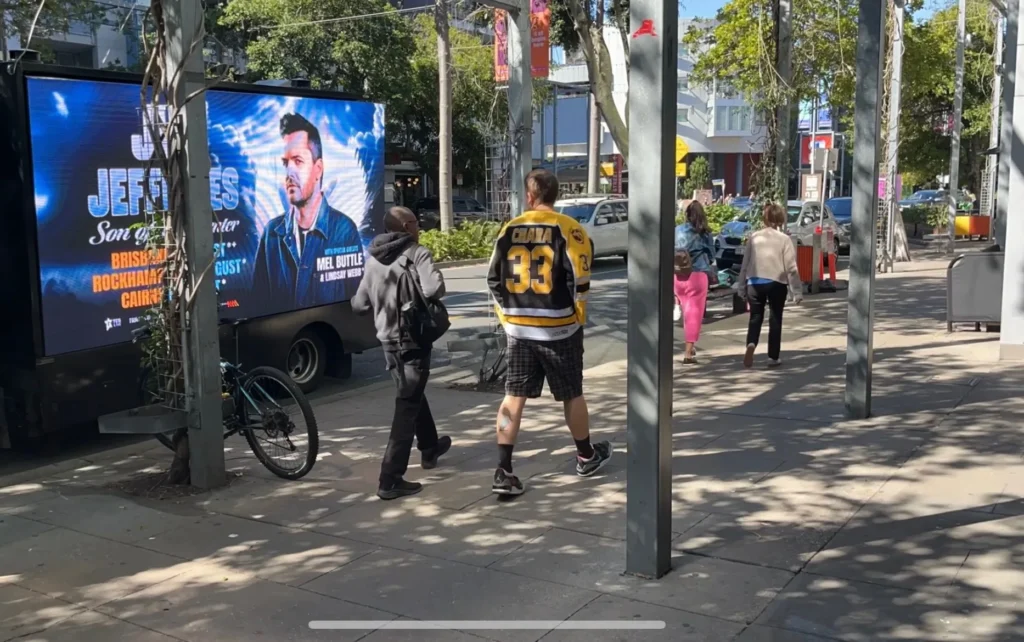
Mobile billboard hire follows one national playbook for booking, creative and reporting, yet plays out three different ways on the road in Melbourne, Sydney and Adelaide. The gap starts with traffic: drivers lost 109 hours to congestion in Adelaide during 2025, more than in either bigger capital, according to TomTom. Identical hire, different route logic.
That split matters at quote time: a route sheet written for one of these capitals underperforms in the other two, because each city moves its people through a different shape at a different speed.
Moving Media builds a separate route strategy for every capital we quote: call Mick direct on 0417 848 150 for a free, no-obligation consult.
The Hire Model Never Changes: Day Rates, Routes and Tracking
Booking a mobile billboard is the same transaction in all three cities: a day-rate hire covering the vehicle, the driver, an agreed route and GPS tracking that verifies the run.
The quote conversation matches too. Asset type, days, target areas and timing get scoped before sign-off, creative arrives as a digital file or a printed skin, and because you hire a vehicle rather than lease a site, there are no landlord negotiations, no long lead times and no four-week minimum cycles anywhere in the country.
The channel around it keeps growing as well. The Outdoor Media Association booked $385 million in out-of-home revenue for the June quarter of 2026, a rise of 5.58 per cent, with digital screens taking 77.1 per cent of spend. Pressure on fixed sites is precisely what keeps a bookable-by-the-day format valuable.
Three Cities, Three Different Audiences on the Move
The audiences differ before a single route is drawn: in scale, in how the road network distributes them, and in how slowly they travel past a screen.
Speed sets the value of every pass. TomTom’s 2025 Traffic Index measured rush hour costing the average driver 109 hours in Adelaide, 103 in Melbourne and 93 in Sydney. Congestion is wasted time for a commuter and bonus dwell time for a moving screen: the more a city crawls, the longer your message stays in view.
Budget behaves differently again, and our guide to what a billboard costs by city and format in 2026 covers that side of the decision. This page stays on the road: how the same hire actually behaves once the wheels turn.
Melbourne Rewards Repetition Along Its Corridors
Melbourne is a corridor city, and mobile billboard hire in Melbourne performs best when one vehicle loops the same high-value routes several times a day.
The flat street grid makes those loops efficient, while trams slow the surrounding traffic and stretch every viewing. The Hoddle Grid concentrates office workers into a tight, walkable core, and inner strips such as Chapel Street and Lygon Street hold shoppers and diners from morning until late, so repetition builds real frequency rather than one-off glances.
Suburban Melbourne is a different job again. Growth runs west, north and south-east, so outer campaigns are planned as separate corridor days rather than one long lap of the metro. Our mobile billboards in Melbourne run both patterns, from CBD loops to growth-corridor circuits.
Sydney Splits Into Precincts, So Routes Should Too
Sydney is a precinct city: water, bridges and tunnels divide the map, and mobile billboard hire in Sydney earns more by owning one region than by crossing several.
The traffic data explains why. Sydney posted the lowest congestion of the three capitals in TomTom’s 2025 Index at 43.7 per cent, largely because motorways carry so much of the load, and free-flowing roads strip away dwell time. Strong Sydney routes lean on signalised intersections, commuter choke points and slow retail strips instead of expressways.
Geography then dictates the brief. The CBD, Parramatta and the wider west, the eastern beaches and the north shore behave like separate campaigns sharing one postcode map, so our mobile billboards in Sydney are routed precinct by precinct rather than end to end.
Adelaide Packs the Whole Metro Into a Single Hire Day
Adelaide compresses the format’s economics: mobile billboard hire in Adelaide can pass most of the metro area’s key precincts inside one day, something neither larger capital allows.
The compact grid ringed by parklands keeps distances short, and TomTom’s 2025 figures make it the medium’s hardest-working market per kilometre, with average speeds of just 19.6 km/h across the year. A screen here spends more of its shift in slow, watchable traffic than it would anywhere else in the country.
Timing multiplies the effect. The February and March festival season fills the CBD and parklands with visitors, and a handful of well-placed days then reaches an audience that would take weeks to assemble in a bigger city. Our mobile billboards in Adelaide are booked around those windows first.
One Hire Day, Hour by Hour: The Route Sheet Compared
The scale sets the ceiling. The Australian Bureau of Statistics counted Greater Sydney at 5.64 million residents, Greater Melbourne at 5.44 million and Greater Adelaide at 1.49 million at 30 June 2025, so the two bigger capitals hold several times the audience across far more ground.
Set the same 7am to 6pm hire day in each capital and the route sheets barely resemble each other. The table maps how a well-planned day typically unfolds, drawing on the geography and traffic patterns above.
| Window in the hire day | Melbourne | Sydney | Adelaide |
| Morning peak | Loop tram-slowed arterials feeding the Hoddle Grid | Hold one choke point feeding a harbour crossing or the Parramatta corridor | Ride the arterials funnelling through the parkland ring |
| Mid-morning | Inner strips such as Chapel Street and Lygon Street | Retail core of the chosen precinct | Full circuit of the CBD grid and North Adelaide |
| Lunchtime | CBD pedestrian core at walking pace | Office towers and lunch strips within the same precinct | North Terrace and the Rundle Mall fringe |
| Afternoon peak | Reverse the morning corridors as traffic flows out | Work the precinct’s homeward choke points | Push into suburban centres, still inside the one day |
| Event evenings | Stadium and arts-precinct approaches | Dining strips in harbour and beach precincts | Festival precincts in season |
Same truck, same driver, same invoice line. The difference between a strong campaign and a wasted one is written entirely in the route sheet, which is why we treat it as the strategy document, not the paperwork.
Where Moving Media Fits: One Fleet, Three Playbooks
At Moving Media, the fleet is identical in all three capitals; only the playbook changes.
Every city runs the same toolkit: mobile digital trucks with panoramic and corner display modes, network digital trucks, solar LED trailers, static 6×3 trailers, and scooter, walking and bike boards, plus access to our exclusive shopping centre partner sites.
Measurement stays constant as well. Our Mobilytics platform reports live impressions and audience mapping during the campaign flight, so a Melbourne loop, a Sydney precinct run and an Adelaide circuit land on one dashboard, measured on identical terms. Every campaign runs 100 per cent carbon neutral through our Reforest partnership, and after more than 25 years in mobile out-of-home, each brief still goes straight to our founder, Mick Diffey, rather than an account queue.
Multi-City Mobile Billboard Hire: FAQs
The questions below come up most often once a campaign crosses city lines.
Can one booking run Melbourne, Sydney and Adelaide at the same time?
Yes. A national operator can field separate vehicles in each capital under a single brief, or tour one unit between cities in sequence. Either way you sign one agreement, brief one team and receive one consolidated report, instead of juggling three suppliers with three quoting styles and three reporting formats.
Does the artwork need to change between cities?
Rarely. Digital creative travels as a file and plays identically on any screen in the network, while printed skins move between capitals whenever the trailer format matches. The one element worth adapting is the call to action, so a Sydney audience is not sent to a Melbourne suburb or a Victorian phone number.
Which city gives a mobile billboard the longest viewing time?
Adelaide. TomTom’s 2025 Traffic Index recorded average speeds of 19.6 km/h there, the slowest of the three capitals, and slower traffic means every pass holds the audience longer. Melbourne runs a close second on its congested corridors, while Sydney’s free-flowing motorways make careful route selection matter most.
How far ahead should a multi-city campaign be booked?
Book as early as the calendar allows, because vehicles are a finite fleet rather than a fixed inventory of sites. Digital-only campaigns can move quickly since creative is just a file, while printed skins add production time, and peak windows such as Adelaide’s festival season and pre-Christmas trading fill first.
Do parking and stopping rules differ between the three cities?
The moving part does not: a driven route operates as a registered vehicle on public roads in all three capitals, with no separate advertising permit. Stationary displays are where rules diverge, because each council treats parked trailers differently and private or event sites need the owner’s approval, which your provider arranges.
Same Hire, Different Driving Plan
The hire works the same in all three cities; the campaign does not, and treating the route sheet as the strategic decision is what separates strong results from wasted kilometres.
Keep the booking, creative and reporting national, let the driving plan go local, and measure every capital on one dashboard. Call Mick direct on 0417 848 150 or book a free campaign consult online, and Moving Media will draft a route strategy for each city before you spend a dollar.
