
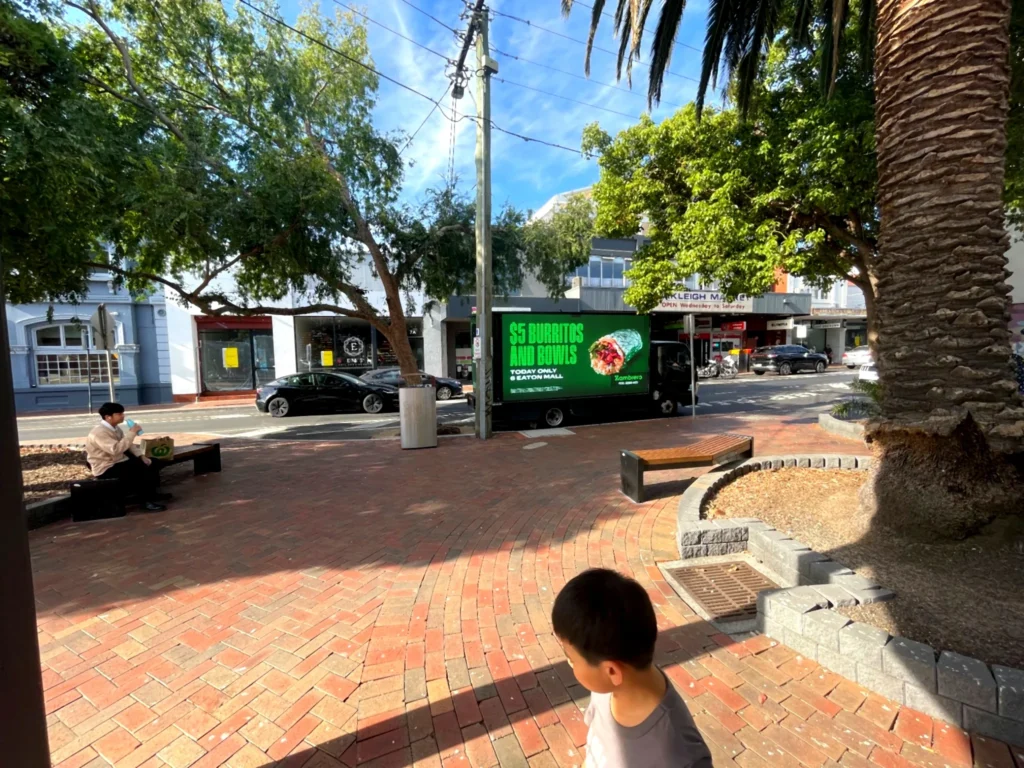
A billboard in Australia costs anywhere from $1,000 to more than $30,000 per four-week cycle in 2026. A static site on a regional highway sits at the low end, a premium metro digital screen sits at the top, and a landmark Sydney CBD position can pass $100,000 per cycle. Where your campaign lands inside that range comes down to three things above all else: location, size and format.
This guide breaks down current billboard advertising prices across Australian cities and formats, what pushes rates up or down, and how to get more from the budget you already have.
How Much Does a Billboard Cost in Australia? The Short Answer
| Format | Typical cost per four weeks (AUD) |
| Small format (bus shelters, street furniture) | $300 – $2,000 |
| Standard static billboard (6m x 3m) | $1,000 – $6,000 |
| Supersite (12.66m x 3.35m) | $5,000 – $15,000+ |
| Digital large format screen | $5,000 – $30,000+ |
| Landmark or spectacular site | $30,000 – $100,000+ |
| Mobile billboard (trailer or truck) | From $400 per day |
These figures cover media space only. Printing and installation for static sites are usually charged on top, and rates move with demand.
Demand is the part most buyers underestimate. The Outdoor Media Association (OMA) reported net media revenue of $1,449.5 million for 2025, up 11.43 per cent on the previous year, with roadside billboards alone contributing $591.5 million of that total. The momentum has carried into this year: Q1 2026 revenue reached $339 million, a 7.41 per cent rise, with digital out-of-home now accounting for 76.7 per cent of spend. Globally, outdoor advertising passed US$77.9 billion in 2025. More advertisers chasing the same sites means firmer prices, particularly in the capitals.
Billboard Advertising Prices by Location
Location is the single biggest price lever in outdoor advertising. The same 6m x 3m skin that costs $1,200 on a regional arterial can cost ten times that overlooking a Sydney motorway, because you are paying for the eyeballs the site delivers, not the steel it hangs on.
| City / area | Typical range per four weeks (AUD) |
| Sydney | $3,000 – $20,000 (landmark CBD sites $100,000+) |
| Melbourne | $2,500 – $15,000 (prime CBD and freeway sites to $25,000) |
| Brisbane | $2,000 – $8,000 (premium digital sites higher) |
| Perth | $1,500 – $10,000 |
| Adelaide | $1,500 – $10,000 |
| Gold Coast and Sunshine Coast | $1,500 – $8,000 |
| Regional Australia | $1,000 – $7,000 (static from about $500 a week) |
Treat these as planning bands drawn from published 2025–26 Australian rate guides and our own market experience, not fixed quotes. Availability, contract length and the individual site all shift the final number, which is covered in more detail in our guide to billboard costs per month.
Why the gap between cities? Three reasons:
- Traffic volume: A Parramatta Road or Monash Freeway site is seen by tens of thousands of vehicles a day. Fewer people passing means fewer impressions, and rates fall accordingly, which is why regional boards are the cheapest way into the medium.
- Dwell time: Sites near congested intersections or signalised crossings hold attention longer than free-flowing highway positions, and owners price that in.
- Audience quality: A board outside an airport or in a high-income catchment commands a premium because the audience matches what many advertisers want to reach. That is also why fixed sites in Sydney, Melbourne and Brisbane sell out fastest, and why mobile alternatives in those cities have grown so quickly: a moving billboard can go to the audience rather than paying a fortune to wait for it.
Billboard Costs by Size and Format
After location, size and format decide the price. Australian outdoor advertising runs on a handful of standard formats, and each sits on a different rung of the cost ladder.
- Small format ($300 to $2,000 per four weeks): Bus shelters, street furniture and panels of around two square metres. Cheap per unit, but you usually need several to build reach.
- Standard 6m x 3m billboards ($1,000 to $6,000): The entry point for classic roadside advertising. Regional sites sit at the bottom of the range; metro arterial positions at the top.
- Supersites, 12.66m x 3.35m ($5,000 to $15,000+): The big freeway-scale boards at roughly 42 square metres. These carry serious presence and are priced to match, especially on motorway approaches in Sydney and Melbourne.
- Digital large format ($5,000 to $30,000+): LED screens sold in shared rotations, typically giving your creative one slot in every six to ten. Digital commands a premium of roughly 20 to 50 per cent over a comparable static site, and buyers keep paying it: digital formats made up 76.6 per cent of Australian OOH revenue in 2025, up from 74.9 per cent the year before.
- Landmark and spectacular sites ($30,000 to $100,000+): One-of-a-kind positions in the busiest precincts in the country. Priced for national brand campaigns rather than local budgets.
- Mobile billboards (from $400 per day): Printed mobile billboard trailers start at around $400 a day, while mobile digital trucks with three-sided LED screens sit higher but give you full-motion creative and route control. Because you hire by the day rather than the four-week cycle, mobile is the only large format that suits short bursts: a launch weekend, an event, a two-week blitz around a specific suburb.
On a cost-per-thousand-impressions basis, static billboards in Australia typically land between $8 and $15 CPM, which stacks up well against roughly $11 for Facebook and far higher rates for television. Bigger formats cost more in absolute terms but often deliver a cheaper CPM, which is why judging a billboard on the monthly invoice alone can be misleading.
What Drives Outdoor Advertising Costs Up or Down?
Beyond location and size, five factors decide the outdoor advertising cost you are actually quoted:
- Campaign length: Billboards are sold in four-week cycles, and most owners discount for three-to-six-month bookings. Committing longer typically saves 20 to 40 per cent against casual rates.
- Timing: Demand peaks in the lead-up to Christmas and around major events. Booking off-peak windows, roughly February to April and September, buys the same site for noticeably less.
- Static versus digital: A static board is yours around the clock; a digital slot shares the screen. Compare the share of voice, not just the headline rate.
- Production and installation: Skins for a supersite, printing and install crews are usually billed separately from media space, so ask for the all-in figure.
- The seller: Rate cards are a starting point. Independents and mobile operators generally have more room to tailor a package than the big fixed-site networks, and multi-asset or long-term bookings attract genuine discounts.
Static, Digital or Mobile: Which Gives Better Value in 2026?
If your audience passes one location reliably every day, a well-chosen static site remains hard to beat on raw CPM. If you need flexibility, scheduling and motion, digital earns its premium. But if your audience moves, or you only need days rather than months, a fixed site means paying for hours when the right people simply are not there.
That is the gap mobile out-of-home fills, and at Moving Media we have specialised in it for more than 25 years. Our trucks and trailers cover every Australian capital plus regional and remote areas, so a Bondi campaign on Saturday can work the Central Coast on Sunday.
Every campaign is tracked through our Mobilytics platform, which reports live impressions, audience heat maps and ROI rather than leaving you to guess what a fixed site delivered. And through our partnership with Reforest, every campaign runs 100 per cent carbon neutral, something no standard billboard contract includes.
Just as importantly for budgeting: you deal directly with our founder, Mick Diffey, get a clear scope before sign-off, and pay day rates instead of locking into four-week cycles you may not need.
How to Budget for a Billboard Campaign in 2026
A simple sequence keeps the spend honest:
- Start with the audience, not the asset: Define who you need to reach and where they actually are before falling for a site.
- Set a CPM benchmark: Divide any quote by the audited impressions on offer. The industry’s new MOVE measurement system, launched in early 2026, now gives audience data across metro and regional formats, so there is no excuse for buying blind.
- Get all-in quotes: Media space, production, installation and any creative changes, on one page, so options can be compared fairly.
- Use the calendar: Book early for peak periods or aim at off-peak windows for the discount.
- Measure and adjust: Favour formats that report real numbers so the second cycle is smarter than the first.
FAQs
How much does a billboard cost per week in Australia?
Fixed billboards are rarely sold by the week; four-week cycles are standard. Divided out, that means roughly $250 a week for a cheap regional static site up to $7,500 or more for premium metro digital. Mobile billboards are the exception, hired by the day from around $400.
How much more do digital billboards cost than static?
Expect a premium of roughly 20 to 50 per cent over a comparable static site, in exchange for motion, scheduling and shared rotations. Digital’s dominance of 76.7 per cent of Australian OOH revenue in early 2026 suggests most advertisers consider the premium worth paying.
Do quoted billboard prices include printing and installation?
Usually not. Published rates generally cover media space only, with skin production, printing and install crews billed separately for static sites. Digital and mobile formats avoid most production costs, since creative is supplied as a file. Always ask for the all-in figure before comparing quotes.
Is a mobile billboard cheaper than a fixed billboard?
For short campaigns, almost always. A printed trailer from about $400 a day undercuts committing $3,000 or more to a four-week fixed cycle, and it reaches multiple suburbs instead of one corner. For six-month, always-on coverage of a single location, a fixed static site can work out cheaper per week.
Get a Straight Answer on Billboard Pricing
Every campaign brief is different, which is why generic rate cards only get you so far. At Moving Media, we provide a free consultation and a no-obligation quote, scoped clearly before sign-off, for mobile billboard campaigns anywhere in Australia. Call Mick directly on 0417 848 150 or book a campaign consult online and get real numbers for your brief within a day.
