
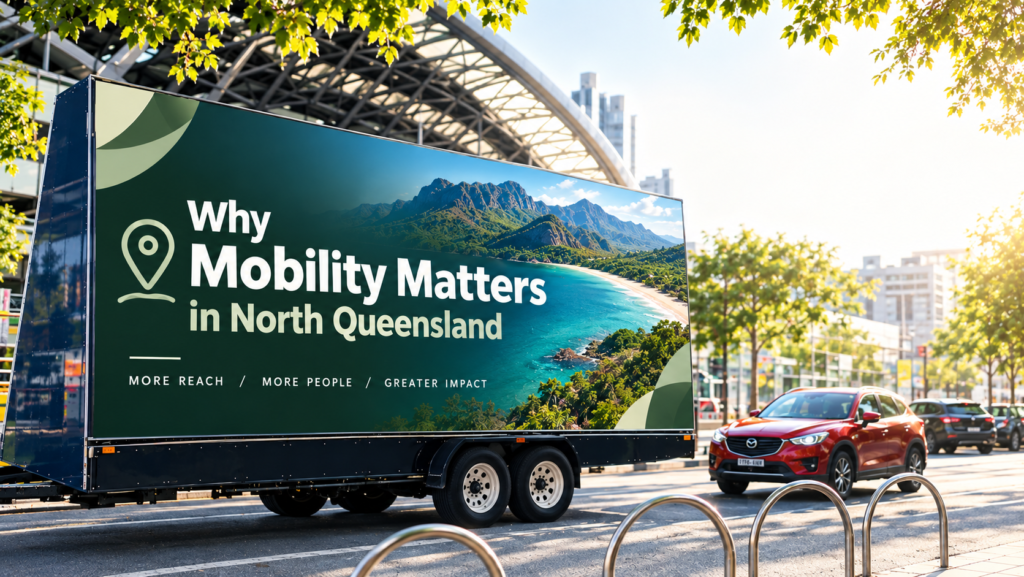
Advertising in North Queensland comes with a practical challenge: audiences are spread across cities, shopping areas, event precincts, major roads and regional communities.
A stationary billboard can only wait for people to pass it. A mobile LED billboard can take the message to different parts of the market.
That distinction matters even more as Australian advertisers move toward digital outdoor formats. In 2025, Digital Out of Home accounted for 76.6% of Australia’s total OOH net media revenue, up from 74.9% in 2024. By the second quarter of 2026, that figure had reached 77.1%.
For businesses planning campaigns across North Queensland, LED billboard trucks combine that digital flexibility with something fixed advertising cannot provide: mobility.
Why Digital Changes the Mobile Billboard Model
A traditional media truck relies on printed vinyl. Once the artwork is produced and installed, changing the campaign generally means creating and fitting new material.
An LED billboard truck works differently.
Digital screens allow campaign content to be changed without replacing the physical advertising surface. Different messages can be scheduled throughout a campaign, allowing advertisers to adapt creatively according to the location, audience, event or timing.
That flexibility becomes particularly useful for campaigns built around:
- Product launches
- Retail promotions
- Sporting events
- Festivals
- Local sales
- Brand activations
- Seasonal campaigns
- Time-sensitive announcements
Moving Media’s North Queensland service also supports custom routes and timings, with real-time content updates and campaign data through its Mobilytics platform.
The Australian OOH Market Is Already Heavily Digital
The shift toward digital is not just an international trend.
Australia’s OOH industry generated $1.4495 billion in net media revenue during 2025, representing an 11.43% increase from 2024. Digital accounted for 76.6% of that revenue.
The momentum continued into 2026. Q1 OOH revenue reached $359 million, a 7.41% year-on-year increase, while digital represented 76.7% of revenue. Q2 generated another $385 million, with DOOH reaching 77.1%.
Australia has also introduced MOVE, a unified OOH audience measurement system designed to provide more consistent data for planning, buying and reporting campaigns across metro and regional markets.
For advertisers, that means digital outdoor advertising is becoming easier to plan and measure rather than functioning only as a broad awareness medium.
Why Mobility Matters in North Queensland
North Queensland presents a different advertising environment from a tightly concentrated CBD.
Major population centres, tourism destinations, shopping precincts, sporting venues and regional communities are separated by significant distances. Audience movement also changes depending on the day, season, event schedule and local activity.
A mobile LED truck can be deployed around those audience concentrations rather than relying on one permanent location.
For example, a campaign could be planned around:
- A stadium before and after a major event
- A shopping precinct during peak retail hours
- A festival or community event
- High-traffic areas during a product launch
- A specific town or postcode
- Several regional centres during one campaign
Moving Media specifically promotes customisable routes and timings across North Queensland, along with the ability to add audio and video and use partner locations such as shopping centres.
The strategy is therefore less about driving as many kilometres as possible and more about putting the screen where the intended audience is concentrated.
What the Latest Performance Research Says
The case for OOH is also becoming more measurable.
A 2026 study from the Out of Home Advertising Association of America and Kochava examined hundreds of campaigns across seven industry verticals. It reported a 20% median lift for in-person outcomes and a 14% median lift for digital outcomes. The comparison benchmark for both connected TV and broadcast television was approximately 10%.
Those figures are not a guarantee of performance for an individual campaign. Results can vary by industry, creative, audience, location and campaign setup.
What they do show is the direction of the medium: OOH is increasingly being evaluated through measurable outcomes rather than exposure alone.
LED Truck or Static Media Truck?
Both formats can have a role, but they solve different advertising problems.
| Campaign requirement | Printed media truck | LED billboard truck |
| One long-running message | Suitable | Suitable |
| Frequent creative changes | Requires new print | Digital update |
| Multiple messages | Limited | Multiple creatives possible |
| Time-specific messaging | Limited | Strong fit |
| Event-based campaigns | Suitable | Strong fit |
| Weather or location-based changes | Not flexible | Can be adapted |
| Campaign reporting | Traditional estimates | Digital data can be incorporated |
| Day and night operation | Requires suitable lighting | Illuminated screen |
A static truck can make sense when the campaign has one core message and needs to remain unchanged for an extended period.
LED becomes particularly useful when timing, message rotation and campaign agility matter.
How to Plan a Better North Queensland Mobile Campaign
A mobile campaign should not be planned around distance alone.
A truck travelling hundreds of kilometres through low-density areas does not necessarily provide better advertising exposure than a shorter route concentrated around high-traffic locations.
A more practical approach is to identify where the target audience is likely to gather and build the route around those periods.
Start With the Audience
Define who the campaign needs to reach before deciding where the truck should travel.
Consider:
- Age group
- Location
- Shopping habits
- Event attendance
- Commuting patterns
- Time of day
- Seasonal activity
Build Around High-Activity Periods
Some audiences are naturally easier to reach during specific windows.
Retail campaigns may benefit from weekend shopping periods. Event campaigns can focus on arrival and departure times. Tourism campaigns may be built around seasonal traffic.
The route should reflect those patterns rather than simply following a fixed daily schedule.
Use More Than One Creative
One advantage of an LED screen is the ability to rotate messages.
A campaign could use one message during the morning, another around a lunch-period audience and a third during an evening event.
The creative can also be adapted for different locations where appropriate.
Measure and Adjust
Campaign data can help identify which routes and time periods are producing the strongest audience concentration.
Moving Media’s Mobilytics platform provides campaign impressions and mapping data during or after the campaign, according to the company’s North Queensland service information.
That creates an opportunity to adjust the campaign instead of waiting until the entire run has finished.
Digital Out-of-Home Is Growing Globally Too
The Australian numbers are part of a broader shift.
The World Out of Home Organization reported that global OOH expenditure reached US$54.2 billion in 2025, up 15% from 2024. Its 2026 forecast puts global OOH expenditure at US$56.4 billion.
Digital OOH generated US$25.5 billion in 2025, representing 47% of global OOH revenue. WOO forecasts that figure to reach approximately US$28 billion in 2026, or 49% of global OOH spending.
Another 2026 market analysis estimates the global digital OOH advertising market at US$22.51 billion in 2026, reaching US$56.1 billion by 2034, with a projected CAGR of 12.09%. Different research organisations use different definitions and methodologies, so these market-size estimates should not be treated as directly interchangeable.
The consistent theme is clear: digital is taking a much larger role in outdoor advertising.
Creative Matters More on a Moving Screen
An LED truck gives advertisers more flexibility, but that does not mean every creative approach will work.
People often have only a short opportunity to notice a mobile advertisement. The message therefore needs to be easy to understand without requiring the viewer to stop and read a paragraph.
Effective mobile-screen creative generally benefits from:
- One clear idea
- Large, readable text
- Strong visual contrast
- Minimal copy
- A recognisable brand
- A simple call to action
- Information that can be understood quickly
The screen should not be treated like a website or brochure.
The campaign’s job is to create recognition and prompt the next step. More detailed information can sit on the website or landing page.
Moving Media’s Mobile Advertising Options
A North Queensland campaign does not necessarily have to rely on one format.
Moving Media provides several mobile advertising options, including digital mobile billboard trucks, network digital trucks, solar LED trailers, static trailers and walking, scooter and bike boards.
That allows a campaign to use different formats for different environments.
A digital truck can cover major roads and event areas, while ground-level formats can extend the campaign into pedestrian locations where a larger vehicle cannot operate.
Moving Media also states that its campaigns are delivered carbon neutral through a reforestation partnership, while its solar LED trailers are designed to operate without relying heavily on grid power.
Frequently Asked Questions
What is an LED billboard truck?
An LED billboard truck is a mobile advertising vehicle fitted with digital display screens. Unlike a printed media truck, its advertising content can be changed digitally without replacing a physical vinyl wrap.
Can LED billboard trucks operate across North Queensland?
Yes. Moving Media provides mobile billboard services across North Queensland and allows campaign routes and timings to be customised around specific locations, audiences and events.
Can the advertising message change during a campaign?
Yes. Digital screens allow campaign content to be updated remotely, making it possible to rotate different creatives or adjust messages during a campaign.
Can mobile billboard campaigns be measured?
Campaign measurement is becoming a larger part of OOH advertising in Australia. MOVE launched in 2026 as the industry’s unified audience measurement currency, while Moving Media states that its Mobilytics platform provides campaign impressions and mapping data.
Is LED advertising better than a static media truck?
The answer depends on the campaign. Static advertising can suit a long-running message that does not need frequent changes. LED advertising provides greater flexibility for multiple messages, event campaigns, time-sensitive promotions and digital content updates.
How should a North Queensland mobile billboard campaign be planned?
Start with the target audience, identify the locations and time periods where that audience is concentrated, then build the route and creative around those opportunities. Campaign data can subsequently help refine the schedule.
Take Your Message to the Audience
North Queensland’s geography makes mobility an important part of outdoor advertising.
Instead of relying entirely on a fixed advertising position, brands can use mobile LED screens to move between audience concentrations, adapt messages during a campaign and incorporate data into campaign planning.
For launches, events, regional promotions and campaigns that need more flexibility than a printed wrap can provide, an LED billboard truck offers another way to put the message directly into the path of the intended audience.
Moving Media provides mobile billboard advertising across Queensland, including North Queensland, with custom routes, digital content updates and campaign measurement options.
Plan a Queensland mobile billboard campaign with Moving Media or call 0417 848 150 to discuss your campaign.
