
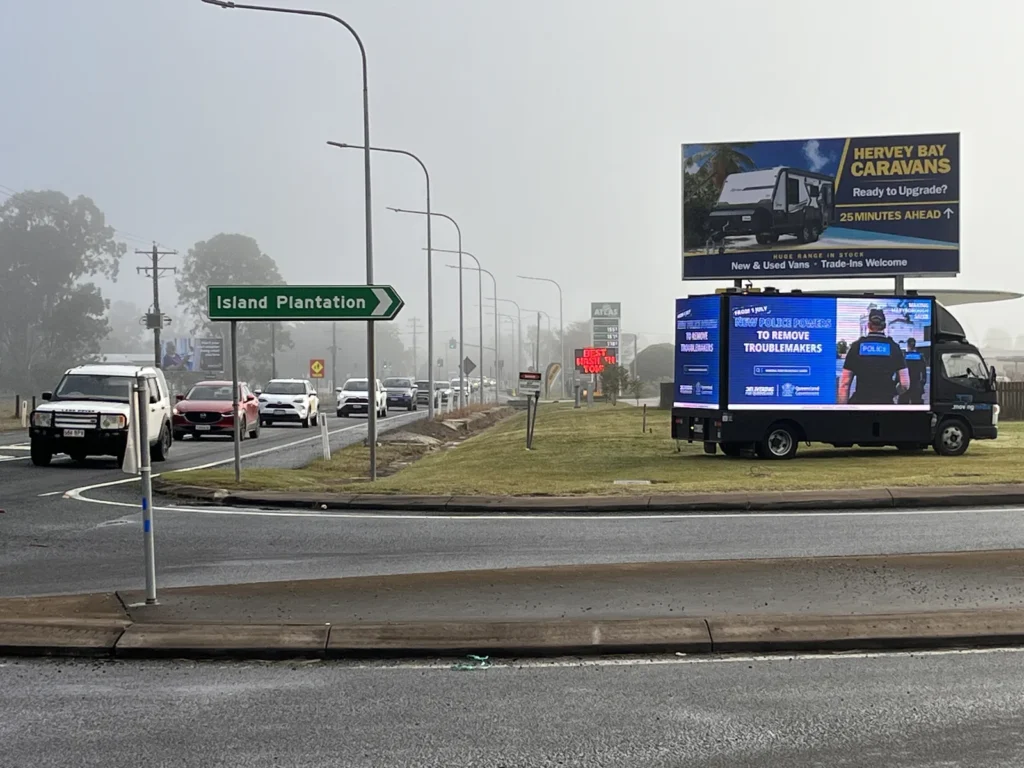
Mobile billboard hire may look like the same service whether a campaign runs in Melbourne, Sydney or Adelaide. The vehicle can be the same, the advertising format can be the same, and the booking process can follow the same basic steps.
The campaign strategy should not.
Each capital has a different population size, road network, congestion profile and pattern of movement. In 2025, TomTom recorded 109 hours of rush-hour traffic delay in Adelaide, 103 hours in Melbourne and 93 hours in Sydney.
Those differences affect how long audiences may remain around a moving advertisement and where a mobile billboard should spend its time.
For Moving Media, that means the route is not simply a logistical detail. It is part of the campaign strategy.
The Basic Mobile Billboard Hire Process
The fundamentals of mobile billboard hire remain consistent between the three cities.
A campaign typically involves selecting the vehicle or advertising format, defining the campaign period, identifying target areas, preparing creative and establishing the route.
GPS and campaign tracking can then be used to document where the vehicle operates.
The difference begins after those basic decisions have been made.
A route that works in central Melbourne may not make sense in Sydney. Likewise, a compact Adelaide campaign should not automatically be planned using the same assumptions as a larger metropolitan campaign.
The latest Australian OOH figures also show why mobile advertising sits within a growing outdoor media environment. The Outdoor Media Association reported $385 million in OOH revenue for Q2 2026, representing 5.58% year-on-year growth, with DOOH accounting for 77.1% of total revenue.
Why City Size Changes the Campaign
The three markets are not comparable in scale.
According to the Australian Bureau of Statistics, the estimated resident populations at 30 June 2025 were:
- Greater Sydney: 5,638,830
- Greater Melbourne: 5,435,590
- Greater Adelaide: 1,491,015
Melbourne added approximately 105,000 residents during 2024–25, Sydney added about 75,200 and Adelaide increased by around 18,600.
That population difference has practical consequences.
A campaign in Adelaide can potentially concentrate its route across a much smaller metropolitan footprint. Sydney and Melbourne require more careful decisions about which parts of the city deserve campaign time.
The objective should therefore be audience concentration rather than kilometres travelled.
Melbourne: Build Frequency Along Strong Corridors
Melbourne’s size makes route discipline particularly important.
TomTom recorded an average congestion level of 52.9% in Melbourne during 2025, with an average rush-hour speed of 21.1 km/h and 103 hours lost to traffic during rush hour.
For mobile billboard campaigns, that creates opportunities around busy corridors where vehicles, pedestrians and retail activity overlap.
Instead of attempting to cover the entire metropolitan area during one campaign day, a more focused strategy can concentrate the truck around selected areas.
Potential campaign zones can include:
- Melbourne CBD
- Inner-city retail strips
- Major shopping areas
- Business districts
- Event approaches
- Growth corridors
- High-traffic suburban routes
Repetition is particularly useful when the objective is brand recognition. Running the same corridor multiple times can provide more consistent exposure than constantly moving into new areas.
Moving Media’s mobile billboards in Melbourne can be planned around the campaign’s intended audience and route requirements.
Sydney: Think in Precincts Rather Than One Long Route
Sydney creates a different planning challenge.
Its population is slightly larger than Melbourne’s, but the city’s geography means a campaign cannot simply be treated as one continuous metropolitan circuit.
TomTom’s 2025 data recorded 43.7% average congestion in Sydney, an average rush-hour speed of 20.8 km/h, and 93 hours of rush-hour time lost over the year.
Sydney’s road network includes major motorways, bridges, tunnels and separated activity centres. For a mobile advertising campaign, that means route selection matters.
A campaign might focus on one of several distinct areas, such as:
- Sydney CBD
- Parramatta
- Western Sydney
- Eastern suburbs
- North Shore
- Major retail precincts
- Event and entertainment areas
Rather than spending campaign time travelling long distances between unrelated locations, the vehicle can be assigned to a defined precinct and its surrounding routes.
Moving Media’s mobile billboards in Sydney can therefore be structured around the audience and locations that matter to the campaign rather than simply trying to maximise road coverage.
Adelaide: Use the Smaller Footprint to Your Advantage
Adelaide presents a different opportunity.
The Greater Adelaide population was approximately 1.49 million in June 2025, significantly smaller than Sydney or Melbourne.
At the same time, TomTom recorded 55.1% average congestion in Adelaide during 2025. Its average rush-hour speed was 20.1 km/h, while drivers lost 109 hours to traffic during rush hour.
That combination can make a concentrated mobile billboard campaign practical.
Instead of dividing the campaign into numerous metropolitan sectors, advertisers can potentially connect several important precincts within a shorter campaign window.
Depending on the campaign objective, routes may include:
- Adelaide CBD
- North Adelaide
- Major retail areas
- Inner suburbs
- Event precincts
- Festival locations
- Key suburban centres
The city’s annual events calendar can also create opportunities for short, highly targeted campaign bursts.
Moving Media’s mobile billboards in Adelaide can be scheduled around those audience peaks rather than following the same route structure used in larger capitals.
The Traffic Numbers Tell Only Part of the Story
Traffic statistics are useful, but they should not be treated as a direct measure of advertising performance.
A slow road can provide more viewing time, but the value of that exposure still depends on who is travelling through the area, how visible the vehicle is, the creative quality and how frequently the audience encounters the message.
The 2025 TomTom data provides a useful comparison:
| City | Average congestion | Average rush-hour speed | Rush-hour time lost |
| Adelaide | 55.1% | 20.1 km/h | 109 hours |
| Melbourne | 52.9% | 21.1 km/h | 103 hours |
| Sydney | 43.7% | 20.8 km/h | 93 hours |
The takeaway is not that one city automatically delivers better advertising results.
It is that the same mobile billboard should be routed differently in each market.
What a Campaign Day Can Look Like
A useful route plan changes according to the city.
| Campaign period | Melbourne approach | Sydney approach | Adelaide approach |
| Morning | Target major commuter corridors | Focus on one high-demand precinct | Work central approach routes |
| Late morning | Retail and inner-city areas | Stay within selected district | CBD and nearby retail areas |
| Lunch | CBD and pedestrian activity | Business and retail precinct | CBD and North Adelaide |
| Afternoon | Follow outbound commuter movement | Target localised congestion points | Expand toward suburban centres |
| Evening | Events and entertainment areas | Dining and entertainment precincts | Events, festivals and CBD activity |
This is not a fixed route template. Actual routing should be developed around the campaign audience, operating conditions, events and vehicle availability.
One Fleet Can Support Three Different Strategies
Moving Media does not need a completely different vehicle fleet for each capital.
The available formats can include:
- Mobile digital billboard trucks
- Network digital trucks
- Solar LED trailers
- Static 6×3 trailers
- Walking boards
- Scooter boards
- Bike boards
- Shopping centre partner locations
The strategic difference is how those assets are deployed.
A digital truck can be useful for a campaign that needs changing creative or multiple messages. A static trailer may suit a longer placement where one message remains relevant. Ground-level formats can extend a campaign into pedestrian environments.
This creates room to build a campaign around the audience rather than forcing every city into one advertising format.
Measurement Should Stay Consistent Across Cities
The route may change from one capital to another, but campaign measurement should remain consistent.
Moving Media’s Mobilytics platform is designed to provide campaign data including impressions and audience mapping. That allows campaigns operating in Melbourne, Sydney and Adelaide to be reviewed using a common reporting approach.
Australia’s OOH industry also introduced MOVE in March 2026, giving advertisers a more developed audience measurement framework for outdoor media. The OMA says the system has delivered more robust audience data for advertisers.
This matters for multi-city campaigns because advertisers can look beyond simply asking where the vehicle travelled.
They can consider:
- Where the campaign operated
- When it operated
- Which areas received exposure
- How the route performed
- How different city strategies compared
- Whether the route should be adjusted during the campaign
Should the Creative Change Between Cities?
Not necessarily.
Digital creative can usually be distributed across multiple locations without redesigning the entire campaign.
However, local adaptations can make sense when the call to action depends on geography.
For example, a national campaign may keep the same brand message while changing:
- Store locations
- Event information
- Local URLs
- Phone numbers
- Promotional dates
- City-specific offers
This keeps the campaign visually consistent while making the final action relevant to the person seeing it.
Multi-City Campaigns Need One Brief but Local Route Planning
A national advertiser does not necessarily need three separate suppliers simply because the campaign covers three capitals.
A single operator can coordinate the overall campaign while applying different route strategies to each city.
That can simplify:
- Creative delivery
- Scheduling
- Vehicle coordination
- Campaign reporting
- Communication
- Performance reviews
The important distinction is between centralised campaign management and local route planning.
The brief can remain national.
The route should remain local.
Frequently Asked Questions
Can one mobile billboard campaign cover Melbourne, Sydney and Adelaide?
Yes. A campaign can use vehicles in multiple cities under one overall campaign brief. The route, schedule and audience strategy can then be customised for each market.
Which city has the most traffic congestion?
Based on TomTom’s 2025 average congestion figures, Adelaide recorded 55.1%, Melbourne 52.9% and Sydney 43.7%.
Congestion should not be treated as a standalone measure of advertising effectiveness, however. Audience composition and route quality also matter.
Which city has the largest population?
Greater Sydney had the largest population of the three at 5,638,830 on 30 June 2025, followed by Greater Melbourne at 5,435,590 and Greater Adelaide at 1,491,015.
Does the same creative work in all three cities?
It can. Digital creative can be used across multiple cities, although local calls to action, offers or event information may be adapted where appropriate.
How should a mobile billboard route be selected?
Start with the target audience and campaign objective. Identify the areas where that audience is most likely to be present, then build the route around traffic patterns, activity periods, events and operating requirements.
Can campaign performance be tracked?
Moving Media states that its Mobilytics platform provides campaign impressions and audience mapping. Australia’s broader OOH market also uses MOVE for audience measurement.
Is mobile billboard rental the same price in every city?
Not necessarily. Pricing can depend on the vehicle format, campaign duration, route, production requirements, number of vehicles and other campaign specifications. A multi-city quote should be assessed based on the actual campaign plan rather than assuming that one city’s rate applies everywhere.
One Campaign, Three Route Strategies
Melbourne, Sydney and Adelaide can all support mobile billboard campaigns, but the same route strategy should not simply be copied from one city to another.
Melbourne’s scale calls for corridor planning and frequency. Sydney benefits from precinct-based routing. Adelaide’s smaller metropolitan footprint can allow campaigns to concentrate activity across a broader share of the market within a shorter period.
The vehicle may be the same.
The creative can be the same.
The reporting framework can be the same.
The route is where the strategy changes.
Moving Media can build city-specific mobile billboard campaigns around your target audience, campaign dates and locations.
Call Mick on 0417 848 150 for a free, no-obligation consultation or book a campaign consultation online.
