
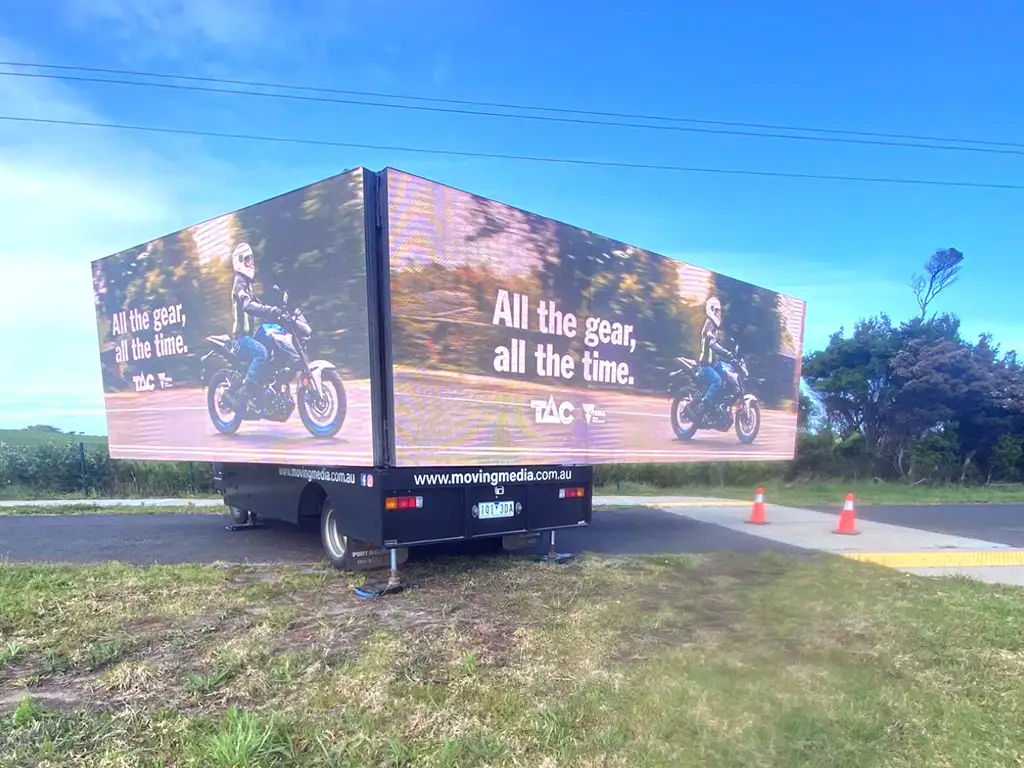
A moving advertising truck outperforms traditional truck advertising because a media planner controls every route, suburb and hour, while a wrapped freight vehicle only reaches whoever its delivery schedule happens to pass. Advertisers keep shifting budget accordingly: Australian out-of-home revenue climbed 7.41% to $339 million in Q1 2026, per the Outdoor Media Association.
That difference in control decides everything downstream: which suburbs see the message, at what hour, how often, and whether anyone can prove it happened.
Ready to put a planned route to work? Book a free, no-obligation consult with us at Moving Media or call Mick directly on 0417 848 150.
What Counts as Traditional Truck Advertising, and What Replaces It?
Traditional truck advertising means a printed wrap or panel riding on a working freight vehicle, while a moving advertising truck is a dedicated media vehicle whose only job is putting your message where you choose. The wrap is a passenger; the media truck is the whole point of the trip.
A wrapped delivery truck follows the logistics diary. It leaves the depot before dawn, spends the day between warehouses and loading docks, and parks overnight in an industrial estate. Any brand exposure along the way is incidental.
A dedicated media vehicle inverts that. The screen or billboard comes first, and the route exists purely to serve it. The format can be a digital truck with LED screens, a towed billboard trailer, or a solar-powered display, but the defining feature is the same: purpose-built movement, planned street by street.
The confusion is understandable, because media schedules label both as truck advertising. That single line item quietly compares a courier’s side panel with a planned media route as though they were the same product, and the budget decision inherits the muddle.
Why Does Route Control Beat Delivery Routes in Perth?
Route control beats delivery routes in Perth because the metropolitan area stretches more than 120 kilometres from Two Rocks to Mandurah, and a message only works on the stretch where your customers actually are. Few Australian cities punish untargeted movement this harshly.
Freight traffic concentrates where freight lives: Kewdale, Welshpool, Canning Vale and the highway links between them, often at hours when the only witnesses are other trucks. A wrap on that journey earns kilometres, not customers.
A planned vehicle works the city’s real audience arteries instead. It can hold the Mitchell Freeway commute in the morning, the Hay Street lunch crowd at midday, school pick-up corridors in the afternoon and the Kwinana Freeway run home after five. Same day, four distinct audiences, zero wasted circuits past a loading dock.
Picture a trade services brand chasing new home builds. Its planned week starts on the Joondalup corridor for the school run, shifts to Wanneroo’s land-release estates through the middle of the day, then finishes on the freeway southbound as tradies head home. A freight wrap cannot make one of those choices; a moving advertising truck makes all three before Tuesday.
Where Is Perth’s Audience Actually Moving To?
Perth’s audience is moving to the fringe, and the numbers are blunt: the Australian Bureau of Statistics reported in March 2026 that Perth grew 2.4% in 2024–25, the fastest rate of any Australian capital, with the largest gains in outer-suburban areas. Scarborough, in the city’s north-west, posted the biggest internal migration gain.
That growth pattern quietly breaks static and freight-borne formats. A fixed sign licensed five years ago now watches yesterday’s traffic, and a delivery wrap still shuttles between the same depots while whole new suburbs fill in around Wanneroo, Cockburn and the south-eastern corridor.
A moving advertising truck absorbs the change without a contract variation. When a new estate opens or a catchment shifts, next week’s route simply follows it.
Retail catchments feel the lag first. New land releases fill with households before fixed signs, leases and printed fleets adjust, which leaves a window where the only media that can reach those buyers is media that moves.
How Do the Two Options Compare for a Perth Campaign?
Side by side, the dedicated vehicle wins on targeting, timing and proof, while the traditional wrap wins only on incidental cost. The table shows why the gap is structural rather than a matter of execution.
| What decides the result | Traditional truck advertising | Moving advertising truck |
| Who plans the route | The logistics schedule | The media plan |
| Where it travels | Depots, highways and industrial estates | Chosen suburbs, precincts and events |
| When it appears | Freight hours, often before dawn | Booked windows matched to the audience |
| Message lifespan | One wrap, locked in for months or years | Swappable content, campaign by campaign |
| Audience proof | None | GPS routes, live impressions, heat maps |
| Cost logic | Cheap add-on to a vehicle already moving | Paid media bought for a defined outcome |
The honest caveat: a wrap on a fleet you already own is close to free branding, and free has its place. The trap is treating that incidental exposure as a campaign. It cannot chase an audience, hit a launch window or report a single number, which is precisely what a paid burst needs to do. In a market as spread out as this one, that structural gap widens, because wasted kilometres here come in tens, not units.
When Does Mobile Truck Advertising Earn Its Keep in Perth?
Mobile truck advertising earns its keep in Perth around the fixtures the whole city moves for: western derby crowds at Optus Stadium, spring wildflower season at Kings Park, the Perth Royal Show and the summer swell of Fringe World in Northbridge. Those windows concentrate exactly the foot and road traffic a planned route is built to intercept.
Between the marquee dates, the same logic applies at a smaller scale. Weekend crowds along the Scarborough foreshore, Fremantle’s cafe strip and major retail precincts give a booked vehicle dense, repeat audiences that no freight corridor ever sees. Our exclusive shopping centre partner sites extend that reach to where Perth actually spends.
Perth also runs on rhythms other capitals lack. The city’s large FIFO workforce cycles home on rostered breaks with money to spend and limited days to spend it, and a route timed to those swings meets a buying window no national media calendar even lists.
How Does Moving Media Run an Advertising Truck in Perth?
At Moving Media, we run every advertising truck in Perth from a local depot, with routes, timings and creative planning around your brief rather than a freight schedule. Our founder, Mick Diffey, brings more than 25 years of marketing and advertising experience to that planning, and you deal with him directly from the first call.
The Perth fleet covers every format this article describes: mobile digital trucks with panoramic and corner-mode screens, network digital trucks, solar LED trailers, static 6×3 trailers, and scooter, walking and bike boards for pedestrian precincts. Audio and video can run on any side of the vehicle, and content updates instantly, so a lunchtime offer can replace the morning message without the truck stopping. The thinking behind that hardware shift is unpacked in our guide to the digital reinvention of mobile billboard truck advertising.
Proof travels with the vehicle. Satellite and data tracking feed Mobilytics impressions and route mapping during the campaign flight or post-campaign, and every booking runs 100% carbon neutral through our Reforest partnership. And when a Perth burst earns a wider rollout, the same planning extends across our Australia-wide network, with international campaigns delivered through partners. Full local details sit on our mobile billboard advertising Perth page.
Frequently Asked Questions
How much does an advertising truck cost in Perth?
Pricing depends on the asset type, the route, the campaign length and any custom creative or activation needs. Longer runs and multi-asset bookings attract better rates, and every cost is scoped in a clear quote before sign-off, so a Perth campaign never carries hidden print, relocation or reporting fees.
Can a moving advertising truck reach Perth events and shopping centres?
Yes. Routes can circle venues such as Optus Stadium on event days, work festival precincts through Fringe World, and activate at exclusive shopping centre partner sites where crowds already gather. Planning handles the practical side, so the vehicle appears where the audience peaks rather than where parking happens to be easy.
Does traditional truck advertising still make sense for anyone?
Yes, in one situation: a business that already runs its own fleet gets near-free incidental branding from wraps, and that residual exposure costs nothing extra. It works as a complement, not a campaign. The moment you need chosen suburbs, timed bursts or reported results, a dedicated vehicle takes over.
How far beyond the Perth CBD can a campaign travel?
The full metropolitan corridor is in play, from Two Rocks and Joondalup in the north to Rockingham and Mandurah in the south, plus growth areas like Wanneroo and Cockburn. Regional and remote Western Australian runs are also available, so a campaign can follow customers well past the city grid.
What reporting does a Perth campaign receive?
Every booked route is satellite-tracked, and Mobilytics reports impressions and location mapping either live during the campaign flight or as a post-campaign summary. You see which suburbs, corridors and windows delivered the audience, which turns the next Perth booking into an optimisation rather than a fresh guess.
How Do You Book an Advertising Truck in Perth?
Booking an advertising truck in Perth starts with a brief, not a booking form: the audience you want, the suburbs they use and the window that matters. A route plan and a clear upfront quote follow, and the campaign can be on the road fast because nothing waits on print.
If it’s mobile marketing in this city, it’s Moving Media. Plan your Perth campaign with a free, no-obligation consult, or call Mick directly on 0417 848 150.
