
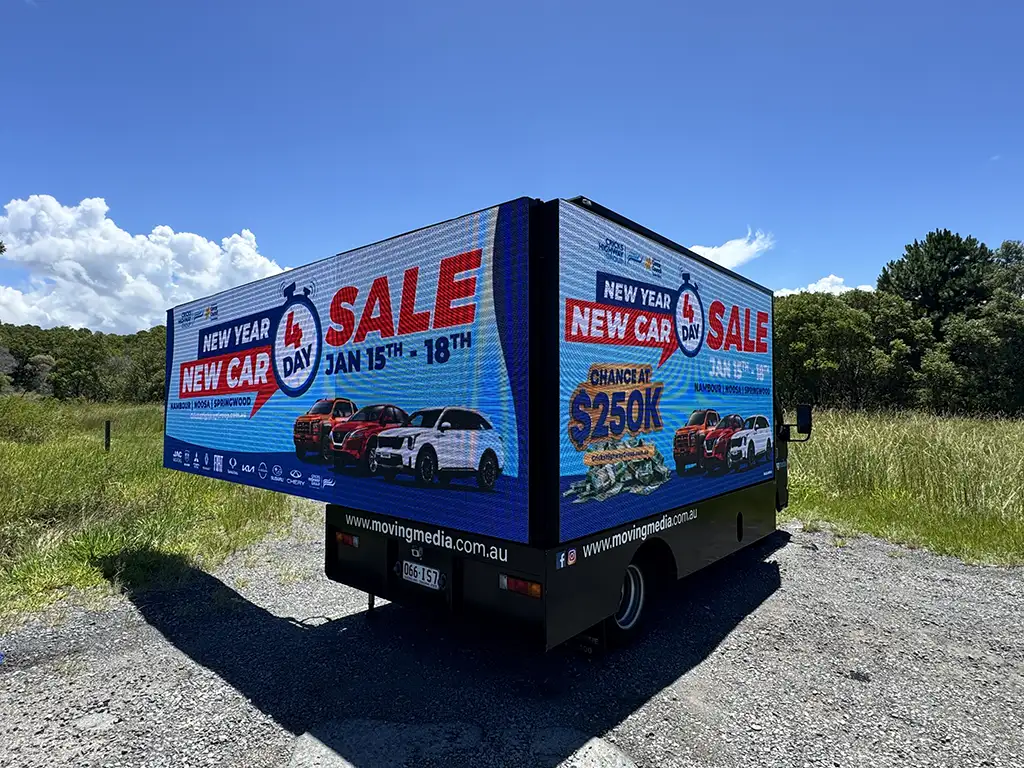
Picture two ads on the same North Queensland highway. One is a printed sign bolted to a post, showing the message it showed last month. The other is a bright LED screen driving a truck straight to the crowd you want, changing its message on the way. That gap is why LED billboard trucks in Queensland pull ahead of older media trucks: they control where the message goes, when it changes, and they prove who saw it.
At Moving Media, we’ve spent 25-plus years running mobile campaigns, and we’ve watched that control decide whether a budget reaches a real audience or drives past an empty road. Here is our case, with the numbers behind it.
What Sets LED Billboard Trucks in Queensland Apart From an Older Media Truck
The difference is not the vehicle. It is the screen bolted to it. A traditional media truck carries a printed vinyl skin: one design, printed once, driven around until the run ends. LED billboard trucks in Queensland carry ultra-bright, multi-sided digital screens with onboard connectivity and GPS, which turns the vehicle into a measurable media channel rather than a poster on wheels.
That single hardware change unlocks things vinyl never could. We can swap creative remotely in minutes instead of reprinting over days, rotate several messages or advertisers across one shift, and react to the time of day, the location, a local event or the weather. Our screens run a panoramic and corner mode, so the message reads clearly whether a driver sees it side-on at the lights or head-on in traffic.
The whole channel is tilting this way. Digital out-of-home is on track to make up 45.2 per cent of total out-of-home ad spend by 2028, up from just 22 per cent in 2016, according to eMarketer’s forecast. A media truck still running static vinyl is fighting that current rather than riding it. For the full breakdown of the shift, our pillar guide on how digital trucks reinvent mobile billboard advertising covers the hardware, the data and the market trend in detail.
The Numbers Behind the Shift
General claims are easy. Here is the hard data behind why advertisers keep moving budgets into digital out-of-home, with sources you can check.
| Metric | Figure |
| Billboard return on investment | About 497%, roughly $6 back per $1 |
| ROI lift when OOH is added to a mobile campaign | Up to 316% |
| Mobile users who act after seeing a digital billboard ad | 74% |
| Out-of-home ad recall | 80–85% |
| Global digital out-of-home market by 2034 | USD 56.1bn, 12.09% CAGR |
Two figures deserve a second look. A 497 per cent return on investment, about six dollars back for every dollar spent, is a benchmark from the Out of Home Advertising Association of America. The more useful one for planning is the 316 per cent lift that comes from adding outdoor to a mobile campaign: mobile billboards work hardest as a multiplier alongside your digital spend, not in isolation. We build campaigns around that principle.
Why the North Queensland Map Rewards a Mobile Screen
North Queensland is not a single dense grid. It is a run of regional centres separated by long stretches of road, tied together by tourism, agriculture, mining and a busy events calendar. Fixed roadside panels sit still and wait for an audience to pass. A media truck in Queensland goes and finds one instead.
That geographic control is the core advantage. We can send an LED billboard truck in North Queensland to circle a stadium before a match, park near a shopping precinct on a Saturday, follow a festival crowd, or saturate a single postcode the day before a sale opens, all with customisable routes and timings and the option to add audio and video on any side of the truck. The tropical north adds one more point in the digital column: self-illuminated LED screens stay legible in harsh midday sun and keep working after dark, without the external lighting a printed panel needs at night.
How to Plan a North Queensland Run That Actually Performs
This is where 25-plus years on the road change the brief. In a dispersed region, reach density beats raw distance: a truck circling three high-traffic precincts at peak flow beats one covering 400 kilometres of quiet highway. The rules we plan by:
- Book the calendar first: North Queensland’s tourism and event peaks concentrate crowds you cannot manufacture on a quiet Tuesday, so we anchor the run to the events calendar, then fill the gaps.
- Target the pulses, not the clock: Event ingress and egress, weekend retail peaks and worksite shift changes are the windows when audiences are dense and slow-moving.
- Stack formats. We pair a digital truck on arterial roads with ground-level walking, scooter or bike boards inside a pedestrian precinct the vehicle cannot enter.
Static Versus LED: A Side-by-Side View
Both formats still earn their place. A printed wrap remains cost-efficient for a long, single-message run. But for brands that need agility and proof across Queensland, the digital approach wins on nearly every modern measure.
| Capability | Static Media Truck (Vinyl) | LED Billboard Truck (Digital) |
| Creative changes | Reprint required, takes days | Updated remotely in minutes |
| Messages per campaign | One fixed design | Multiple, rotating or time-of-day |
| Performance data | Estimated impressions only | Live impressions and heat maps |
| Real-time reactivity | None | Weather, location and event triggers |
| Day and night visibility | Needs external lighting | Self-illuminated LED |
| Best use case | Long single-message runs | Launches, events, agile regional pushes |
The practical read: brief a digital truck for launches and event work where timing and reactivity count, and keep static in mind for steady, longer awareness runs where one message does the job.
Measurement Turns a Media Truck in Queensland Into a Performance Channel
The clearest line between the two formats is proof. The old pitch ended at “plenty of people will see it.” The new standard is a dashboard. Our Mobilytics data and analytics platform tracks live impressions, audience heat maps and route performance, with satellite and data tracking for accurate location and post-campaign reporting. The workflow that gets results is simple: we set a baseline in the first week, read the heat maps, then shift the truck’s hours toward the routes and windows pulling the highest density. Guesswork gets replaced by evidence within days, not at the end of the campaign.
Retargeting is where the format compounds. People are 48 per cent more likely to interact with a mobile ad once they have already seen a version of it on a billboard. Mobilytics supports digital retargeting after the vehicle has moved on, so the audience we reached on the road can be reached again online while the memory is fresh.
Getting the Creative Right on a Moving Screen
A common and costly mistake is treating a moving LED screen like a static poster with motion added. A driver or pedestrian has a few seconds at most, so the medium rewards ruthless restraint. The creative way we see land from a moving vehicle follows the same shape: one idea per screen, roughly six words or fewer, a single high-contrast focal image, and the brand visible inside the first second. Save the detail and the fine print for the landing page the ad drives people to. Get this right and the format’s reach and timing advantages register instead of blurring past.
The Assets We Run Across Queensland
A regional campaign rarely needs one asset type. We run a mix so the plan fits the brief: mobile digital trucks (described as Australia’s brightest and clearest three-sided LED screens), network digital trucks for wider coverage, solar LED trailers that run day and night with a lighter environmental load, static 6×3 trailers for cost-efficient placement, and ground-level walking, scooter and bike boards for pedestrian reach. Compare the full digital option on our mobile digital trucks page, or see how the state-wide service works on our Queensland mobile billboards page.
There is a sustainability point worth noting too. Every campaign we run is delivered carbon neutral through a reforestation partnership, and our solar-LED trailers run without drawing heavily on the grid. For brands under pressure to hit environmental targets, that removes the old trade-off between visibility and values.
Frequently Asked Questions
What is the difference between an LED billboard truck and an older media truck in Queensland?
An older media truck carries a fixed printed wrap with one message. An LED billboard truck uses digital screens that update remotely, so you can rotate several messages, change creative mid-campaign, run day and night, and track live impressions. A printed panel can do none of those things.
Do you cover regional North Queensland or just the cities?
Both. We operate across Queensland, including regional and remote areas of North Queensland, and tailor each run to specific towns, precincts and events rather than only metro centres.
Can I measure the results of a mobile billboard campaign?
Yes. Mobilytics tracks live impressions, audience heat maps and route performance during the campaign and afterwards, with satellite and data tracking for location accuracy and options for digital retargeting once the truck has finished its run.
How quickly can a digital campaign go live?
A digital campaign avoids print lead time because the artwork lives on the screen rather than on vinyl, so it can start faster than a printed wrap, and we can still update the creative remotely while the campaign is running. Exact timing depends on the assets and route, which we scope with you upfront.
Plan Your Queensland Campaign
If you have a launch, event or regional push coming up, talk it through with us before you commit. Plan your campaign with Moving Media for a free, no-obligation consult and a clear quote upfront, or call Mick directly on 0417 848 150.
