
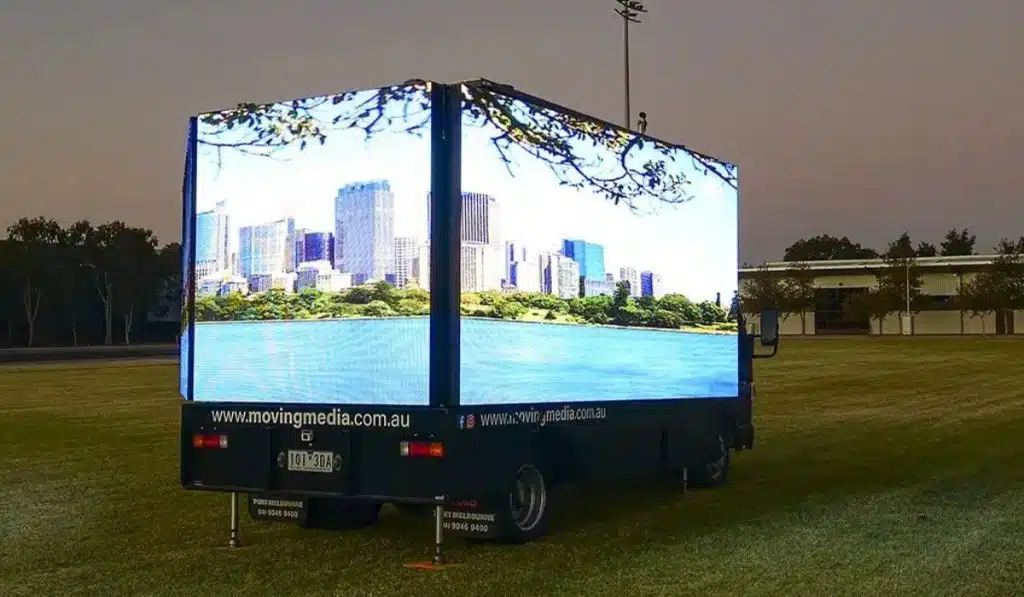
For decades, mobile billboard truck advertising meant one thing: a printed vinyl skin wrapped around a trailer, towed along a fixed loop, hoping the right people happened to be looking. It worked, but it was blunt. You could not change the message mid-campaign, you could not prove who saw it, and you could not react to weather, traffic or a competitor’s move on the same day. That model is now being rebuilt from the ground up.
After more than 25 years moving brands through Australian streets, the single biggest change we have witnessed is the jump from static vinyl to fully programmable LED. The truck still drives, but everything bolted to it now behaves like a connected digital channel rather than a poster on wheels.
What Actually Changed Under the Hood
The reinvention is not cosmetic. Older mobile advertising trucks were essentially mobile posters: print it once, drive it around, take it down. The new generation carries ultra-bright, multi-sided LED screens, onboard connectivity and GPS, which together turn a vehicle into a measurable media platform. That single hardware shift unlocks capabilities the old format never had.
- Creatives can be swapped remotely in minutes instead of being reprinted over days.
- Several messages, or several advertisers, can rotate across one run.
- Content can react to time of day, location, live sport or weather.
- Motion and animation hold attention that a flat panel simply cannot.
The data supports the upgrade. Motion-based outdoor ads are roughly 81% more effective at grabbing attention than static creative, and digital billboards can attract up to 400% more views than their printed equivalents, according to aggregated billboard research.
Static Versus Digital: A Side-by-Side View
Both formats still earn their place. Static wraps remain reliable and cost-efficient for long, single-message campaigns. But for brands that need agility and proof, a digital approach to mobile billboard truck advertising wins on almost every modern metric.
| Capability | Static Vinyl Truck | Digital Mobile Advertising Truck |
| Creative changes | Reprint required (days) | Remote update (minutes) |
| Messages per campaign | One fixed design | Multiple rotating or dayparted |
| Performance data | Estimated impressions | Live impressions and heat maps |
| Real-time reactivity | None | Weather, location, event triggers |
| Day and night visibility | Needs external lighting | Self-illuminated LED |
| Best use case | Long single-message runs | Launches, events, agile campaigns |
This is why agencies increasingly brief a digital mobile advertising truck for product launches and event work while keeping static options for steady, longer brand-awareness pushes.
The Reach Problem That Mobile Solves
Fixed billboards wait for an audience to pass. Mobile advertising trucks go and find one. They can circle a stadium before kickoff, park outside a competitor’s flagship store, follow a festival crowd, or saturate a single postcode the day before a sale. That geographic control is the core advantage that printed roadside panels can never match, and it is amplified when the screen itself is dynamic.
It matters because out-of-home (OOH) remains one of the most trusted and memorable channels available. The Out of Home Advertising Association of America reports that OOH delivers an 84 to 86% ad recall rate, close to double the recall of typical online and social ads. A truck takes that high-recall medium and removes its biggest historical weakness: a fixed location.
The Market Is Moving the Same Direction
This is not a fringe tactic. The global digital out-of-home market was valued at roughly USD 20.17 billion in 2025 and is projected to climb to USD 22.51 billion in 2026 on its way to USD 56.1 billion by 2034, a 12.09% compound annual growth rate, per Fortune Business Insights. Within that surge, mobile billboard truck advertising is one of the fastest-evolving segments
precisely because it pairs the reach of outdoor with the flexibility of digital.
Spend follows attention, and attention follows screens. As budgets shift toward measurable, reactive formats, the digital truck sits exactly where two trends meet: the durability of physical advertising and the accountability brands now expect from every dollar.
Measurement Is the Real Reinvention
If one thing separates today’s mobile advertising trucks from the vinyl era, it is proof. The old pitch ended at “Lots of people will see it.” The new standard is a dashboard. Our own Mobilytics measurement and analytics platform tracks live impressions, audience heat maps and route performance, with options for digital retargeting after the vehicle has moved on. That closes the loop that traditional outdoors never could. You see where impressions landed, when they peaked, and which routes delivered the strongest audience density, and then you optimise the next run accordingly.
This accountability changes the conversation with finance teams. Outdoor advertising already posts a strong return: the OAAA estimates billboards can deliver up to a 497% return on investment, and adding OOH to a mobile ad campaign can lift overall ROI by as much as 316%. When you can prove delivery rather than estimate it, a digital mobile advertising truck stops being a “brand” line item and starts behaving like a performance channel.
Creative Has to Earn the Extra Power
A common mistake we see is treating a moving LED screen like a static poster with motion bolted on. The medium rewards discipline. One idea per screen, high contrast, and a single clear call to action consistently outperform busy layouts, and simple creative can lift recall by up to 60% over cluttered designs.
The payoff is real: research cited in billboard advertising data shows that 74% of mobile users take some action, such as searching, calling or visiting a store, after seeing a digital billboard ad. When the screen is also mobile, you can place that prompt at the exact moment a buying decision is being made, which is where mobile advertising trucks separate themselves from every fixed format.
Where Digital Trucks Outperform in the Real World
In practice, the format earns its keep in a few repeatable scenarios:
- Launches and pop-ups: Saturate a precinct for 72 hours, then redeploy.
- Event domination: Circle a venue with creativity timed to the schedule.
- Competitive conquesting: Place your message exactly where rivals operate.
- Hyper-local campaigns: Target a single suburb the day a store opens.
Each of these leans on the same strengths: control over place, control over timing, and control over message. A well-run campaign in a dense market such as our mobile billboards across Sydney can route a vehicle through multiple high-traffic zones in a single shift, something no fixed panel can replicate.
The Sustainability Upgrade
Reinvention is not only about screens. The category has cleaned up its footprint too. Solar-ready hardware and cleaner logistics now sit alongside carbon-offset programmes, so brands no longer have to choose between visibility and values.
Every Moving Media campaign is delivered carbon neutral through our reforestation partnership, and our solar-LED trailers extend that thinking to displays that run day and night with a lighter environmental load. For marketers under pressure to hit sustainability targets, that is a meaningful part of the modern value proposition.
What This Means for Your Next Campaign
The honest summary, after years in the field: the truck was never the limitation. The limitation was the static panel bolted to it. Replacing that with a programmable, measurable screen and mobile billboard truck advertising becomes one of the most flexible, accountable formats in the mix, not a legacy tactic.
If you are weighing options for an upcoming launch, event or regional push, the practical advice is simple. Lead with objectives, not hardware. Decide whether you need agility and live data (digital) or long, steady single-message coverage (static), then match the asset to the brief. The brands seeing the strongest results treat their digital mobile advertising truck as a connected channel, integrate it with their online retargeting, and judge it on measured delivery rather than guesswork.
Ready to put it to work? Plan your campaign with Moving Media for a free, no-obligation consult and a clear quote upfront.
Frequently Asked Questions
How is a digital mobile advertising truck different from a traditional billboard truck?
A traditional billboard truck carries a fixed printed wrap, while a digital version uses LED screens that update remotely. The digital format allows multiple rotating messages, real-time creative changes, day-and-night visibility and live impression tracking, none of which a printed panel can offer.
Do mobile advertising trucks actually deliver measurable results?
Yes. Modern platforms track live impressions, audience heat maps and route performance, so you see where and when your message landed. Outdoor advertising also posts strong returns, with the OAAA reporting billboard ROI of up to 497%, and digital tracking lets you optimise each run rather than estimate outcomes.
Is mobile billboard truck advertising suitable for small or local businesses?
Absolutely. One of the biggest strengths of the format is hyper-local control. A single truck can saturate one suburb or circle one venue, making it a cost-effective way for local businesses to dominate a specific area without paying for wasted regional reach.
How quickly can a campaign go live and can the creative change mid-run?
A digital campaign can launch fast because there is no print lead time, and the artwork lives on the screen rather than on vinyl. That also means creative can be updated remotely during the campaign, so you can refresh an offer, react to weather or rotate messages across the same booking without pulling the vehicle off the road.
What determines the cost of a mobile advertising truck campaign?
Pricing depends on a few clear factors: the asset type, the city or route, the campaign duration, and any custom creative or special activation needs. Longer runs and multi-asset or multi-location bookings usually attract better rates, and every cost is scoped and quoted upfront before sign-off, with no print or relocation surprises.
