
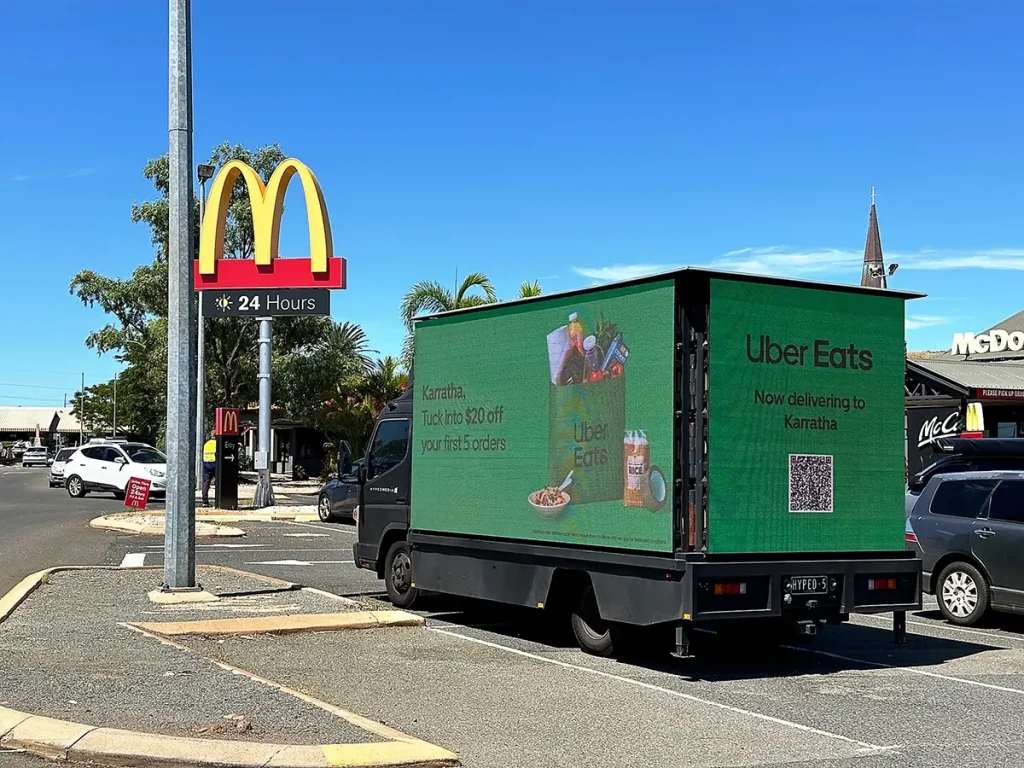
Outdoor advertising has entered a new era. Brands no longer rely only on fixed structures placed along highways or major roads. Modern campaigns demand flexibility, measurable reach, and the ability to meet audiences where they actually move. That shift explains why mobile billboard advertising has become one of the fastest-growing segments in the out-of-home (OOH) industry.
Powered by mobile advertising trucks, these campaigns deliver visibility across cities, events, and neighbourhoods with the adaptability that traditional formats cannot match. At Moving Media, we see this transformation every day. Brands are choosing mobile formats because they combine movement, data, and real-world engagement in ways that static media cannot replicate.
The Rise of Mobile Billboard Advertising
Outdoor advertising continues to grow globally, but the momentum is concentrated in digital and mobile formats. The mobile billboard segment reached approximately $4.60 billion in 2025, representing around 14% of the total billboard and outdoor advertising market. Analysts expect the segment to grow at a 4.8% CAGR, driven by rising demand for flexible, measurable advertising formats.
This growth sits within a broader industry expansion. The global outdoor advertising market increased from $57.83 billion in 2025 to $59.18 billion in 2026, with mobile and digital technologies driving much of that growth. Brands today want campaigns that move with the audience. Mobile billboard advertising delivers exactly that.
What Mobile Advertising Trucks Actually Do
Mobile advertising trucks are specialised vehicles equipped with large-format displays, digital LED screens, or printed panels designed for advertising visibility.
Instead of waiting for traffic to pass a fixed billboard, these vehicles move strategically through areas where audiences are already active.
Common campaign routes include:
- City centres and CBD corridors
- Event venues and stadium districts
- Retail and shopping areas
- High-traffic commuter routes
- Regional towns with limited billboard infrastructure
By moving through these environments, mobile billboard advertising delivers brand messages directly to target audiences throughout the day.
Exceptional Brand Recall Rates
One of the most compelling advantages of mobile billboard advertising is its ability to generate strong audience recall.
Research consistently shows impressive performance metrics:
- The Transportation Advertising Council reports 97% recall rates for mobile truck advertising.
- A survey by Outdoor Ad Magazine found 96% of respondents consider mobile advertising more effective than traditional static billboards.
- Research from the RYP & Becker Group shows 97% of people remember vehicle ads, while 96% say they are more impactful than standard billboards.
These results highlight a key advantage: movement attracts attention. A branded vehicle travelling through a busy urban environment naturally captures curiosity and visual engagement.
Mobile Campaigns Deliver Massive Reach
Visibility is another major reason brands invest in mobile billboard advertising. A single advertising truck can generate remarkable impression numbers over time.
Industry estimates show:
- A standard box-van advertising truck produces around 6.4 million impressions annually.
- Daily exposure averages roughly 80,000 impressions per vehicle.
- Long-distance semi-trailer campaigns can reach over 24 million impressions per year.
The Outdoor Advertising Association of America also reports that fleet vehicle advertising can increase brand name recognition by up to 15 times compared with campaigns that rely solely on static exposure. For brands seeking broad urban reach, mobile advertising trucks offer enormous visibility potential.
Strategic Flexibility for Modern Campaigns
Another advantage of mobile billboard advertising lies in its ability to adapt quickly. Traditional advertising billboards remain fixed in one location for weeks or months. In contrast, mobile campaigns can respond to real-world conditions almost immediately.
Brands often deploy mobile advertising trucks to reach:
- Event audiences before and after concerts or sporting matches
- Festival crowds and cultural gatherings
- High-traffic shopping districts during promotional periods
- Specific neighbourhoods targeted for local marketing
Because the vehicles move throughout the day, campaigns can maximise visibility during peak hours rather than relying on static exposure. This flexibility explains why 52% of event-based marketing campaigns now include mobile billboards in their strategies.
A Cost-Efficient Advertising Channel
Cost efficiency is another factor behind the growth of mobile billboard advertising. Mobile truck campaigns often cost two to three times less than traditional billboard placements, particularly when brands consider the flexibility and movement included in the campaign. Outdoor advertising already delivers strong value compared with many digital channels.
Billboard campaigns in 2025 typically generate CPMs between $2 and $7, while the broader OOH category averages $5.97 per dollar spent. Mobile formats extend this efficiency by delivering impressions across multiple locations rather than a single fixed site. For local businesses and national brands alike, this balance between cost and reach makes mobile advertising trucks an attractive investment.
Mobile OOH Aligns With Audience Behaviour
Modern audiences no longer move in predictable patterns. Work schedules, commuting routes, and lifestyle habits have changed significantly over the past decade. Mobile billboard advertising reflects these new realities by tracking audience movement rather than waiting for it.
Campaigns can travel through:
- Commuter corridors during morning traffic
- Business districts during lunch hours
- Entertainment precincts in the evening
- Residential suburbs during weekends
This adaptability ensures brand messages remain visible throughout the day in environments where audiences naturally gather. The result is advertising that feels present within daily life rather than confined to a single roadside structure.
Data-Driven Campaign Measurement
One of the biggest transformations in the outdoor advertising industry is the shift toward real-time measurement. At Moving Media, our mobile campaigns integrate location-based analytics through technologies such as Mobilytics. These systems collect data from devices that pass within range of our advertising assets.
This data helps track:
- Opportunity-to-see impressions
- Audience density in specific locations
- Route performance and exposure patterns
- Engagement potential across campaign zones
These insights allow brands to evaluate campaign performance with real evidence rather than estimates from traffic models. This data-driven approach also connects with broader industry discussions about how mobile billboard advertising is reshaping the outdoor media landscape. The ongoing evolution from static placements toward mobile visibility is examined further in “Why Billboard Advertising Is Evolving From Static Billboard Advertising to Mobile Impact.”
Why Local Businesses Are Embracing Mobile Advertising
Mobile billboard advertising is not only used by large brands. Local businesses are increasingly adopting it as part of their marketing strategy.
Industry research indicates 37% of local businesses now integrate mobile billboards into their promotional campaigns.
This popularity stems from several advantages:
- Campaigns can target specific suburbs
- Shorter campaign durations are possible
- Routes can align with local events or seasonal activity
- Visibility increases within the communities businesses serve
For regional campaigns, mobile trucks can also reach areas with limited or no traditional billboard infrastructure.
Sustainability in Modern Mobile Advertising
Environmental responsibility has become an important consideration in advertising operations. At Moving Media, we run 100% carbon-neutral campaigns through our partnership with Reforest. Every campaign offsets emissions through verified reforestation projects across Australia.
These projects:
- Support ecosystem restoration
- Contribute to biodiversity protection
- Offset operational emissions from advertising vehicles
Clients can track these initiatives through transparent dashboards that show the number of trees planted and the carbon offsets achieved. Sustainable practices ensure that the growth of mobile billboard advertising aligns with environmental responsibility.
The Future of Mobile Billboard Advertising
The rise of mobile advertising trucks reflects a broader transformation in how brands approach outdoor media.
Modern campaigns demand:
- Flexible deployment
- Verified performance data
- High audience recall
- Strong cost efficiency
- Targeted geographic reach
Mobile billboard advertising delivers on all of these priorities. As cities continue to evolve and audiences move through increasingly dynamic environments, mobile advertising will likely play an even larger role in outdoor media strategies. At Moving Media, we help brands connect with audiences where attention naturally exists.
By combining strategic routes, real-time data, and high-visibility assets, mobile advertising trucks bring brand messages directly into the environments where people live, work, and gather. In the modern OOH landscape, mobility is no longer an experiment. It has become a central driver of how billboard advertising reaches audiences today.
Frequently Asked Questions
What are mobile advertising trucks?
Mobile advertising trucks are vehicles equipped with large advertising displays or digital screens. They travel through cities, event areas, and commercial districts to deliver mobile billboard advertising messages directly to audiences throughout the day.
Why are mobile advertising trucks effective for brand visibility?
Mobile trucks attract attention because they move through busy areas and high-traffic routes. Studies show recall rates of up to 97%, making them one of the most memorable formats in the outdoor advertising industry.
How many impressions can mobile billboard advertising generate?
A single mobile advertising truck can generate approximately 80,000 impressions per day, or around 6.4 million impressions per year, depending on route density and traffic conditions.
Are mobile billboard campaigns suitable for small businesses?
Yes. Mobile billboard advertising allows businesses to target specific neighbourhoods or events. Many local brands use mobile trucks for flexible campaigns that reach audiences in their immediate service areas.
How is performance measured in mobile billboard advertising?
Modern campaigns use location analytics and sensor-based tracking to estimate exposure opportunities. These tools help advertisers understand route performance, audience density, and campaign reach across different areas.
