
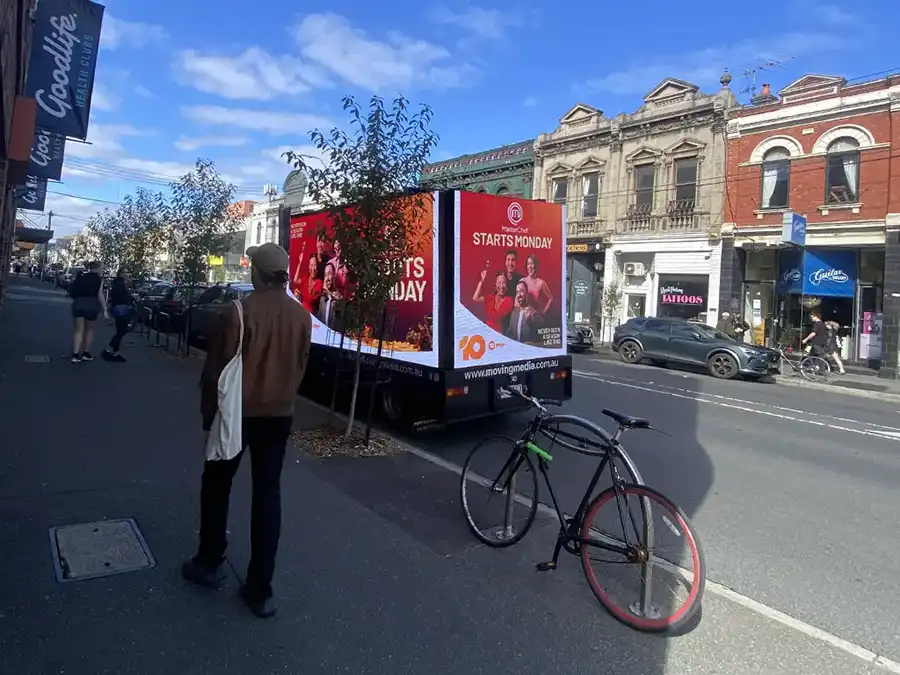
Hiring an outdoor advertising company is a different decision from picking a billboard. The billboard is a piece of inventory. The company is the partner deciding which inventory you see, how it’s measured, and whether your spend actually moves your brand. Get the partner wrong and even a perfect site underdelivers. Get it right and a modest budget can outperform campaigns that cost three times more.
Australia’s OOH market hit $1.4 billion in net media revenue in 2025, with digital out-of-home now driving more than three-quarters of that spend. That growth has pulled in more operators, more formats, and more sales reps quoting prices that all sound reasonable on a phone call. This guide is for the marketer or business owner who needs a working filter before signing anything.
If you already know mobile OOH fits your brief, call Mick direct on 0417 848 150 and skip the procurement dance. Otherwise, here’s what to test before you commit a dollar.
Start With the Question: Are They Selling Inventory or Solving Your Brief?
Most outdoor advertising companies in Australia are inventory-led. They own panels or have rep agreements with panel owners, and the conversation starts with what’s available. That’s fine when your campaign matches what’s on offer. It’s a problem when it doesn’t.
The first filter is simple. In your first call, count how many minutes they spend asking about your audience, launch dates, geographic priorities, and success metrics versus how many minutes they spend pitching sites. If the ratio is upside down, you’re being sold to, not consulted with.
This matters because OOH boosts brand recall by 47% when combined with digital campaigns according to Nielsen research, but only when the placement actually reaches the right audience at the right moment. A partner who doesn’t ask about your audience cannot deliver that lift.
Check Their Measurement Stack Before You Look at Anything Else
Old-school OOH was sold on “estimated impressions” pulled from traffic counts. Those numbers were never wrong on paper and rarely useful in practice. The industry has moved on, and any outdoor advertising company quoting you in 2026 should be able to show:
- Verified audience metrics: For static and digital fixed panels, that means MOVE 2.0 data, the industry standard rolled out across Australia. For mobile OOH, that means a proprietary sensor and reporting platform.
- Post-campaign reports with real numbers: Unique impressions, dwell time, route maps for mobile, and retargeting pools where applicable.
- Sample reports on request: A vendor that can’t show you what you’ll receive after the campaign is asking you to pay for a black box.
Moving Media runs every campaign through Mobilytics, which tracks every device that passes our screens and produces a minute-by-minute report. Past campaigns have logged outputs like 650,000 impressions in a single day across Brisbane and the Sunshine Coast, with retargeting pools rolling on after the truck stopped moving. If your shortlisted vendor can’t match that level of post-campaign clarity, the gap is real.
Audit the Fleet and Format Mix
A genuine outdoor advertising company gives you options because briefs vary. A truck doesn’t fix every problem, and neither does a fixed digital panel. Look for:
- Multiple mobile formats (digital trucks, solar LED trailers, walking boards, printed trailers, custom builds)
- Coverage across metro and regional Australia, including NZ where relevant
- Activation modes beyond the standard drive cycle, like panoramic event mode for stadium-day campaigns or corner mode for high-foot-traffic intersections
Moving Media operates nine mobile formats across the country, which means the brief drives the recommendation rather than the reverse. If a vendor only owns one or two formats, expect every recommendation to come back as the format they own.
Ask How They Handle Routing, Timing, and Daypart Strategy
For mobile OOH, the route is the campaign. For static and digital panels, the daypart is the campaign. A serious outdoor advertising company will brief you on both before sending a quote.
Useful questions to ask:
- For a mobile campaign, what’s the planned route, why those streets, and at what times?
- For a digital panel, what’s the loop length, and how many other advertisers share rotation?
- Can routes or creatives shift mid-campaign based on Mobilytics or MOVE data?
- What happens if a route underperforms in the first 48 hours?
A vendor who can’t answer these in plain English is selling space, not outcomes. Routeing matters because 70% of Australians travel past an outdoor advertising site daily, but reach without the right adjacency is just wasted CPM.
Confirm Carbon Reporting Is Built In, Not Bolted On
Sustainability disclosures are increasingly an ESG and procurement requirement, not a marketing nice-to-have. A 2025 commitment across the UK industry already targets 100% recyclable or reusable outdoor advertising materials, and Australian buyers are heading the same direction.
What to look for from an Australian outdoor advertising company:
- Documented carbon offset partnerships (reforestation, renewable energy credits, or both)
- Solar-powered mobile units where the brief allows
- A reporting dashboard showing your campaign’s environmental impact
Moving Media’s campaigns are 100% carbon neutral through a Reforest partnership, and every client receives a tree-planting dashboard tied to their specific activation. If your shortlisted vendor treats sustainability as a website page rather than a line in the campaign report, that’s a flag.
Pressure-Test the Quote Against the Pillar Cost Ranges
Before you sign, benchmark every quote against the real market. Australia’s billboard ad cost ranges sit at the following:
- Static metro panels: $2,000 to $10,000 per week in Sydney and Brisbane
- Digital fixed panels: $5,000 to $15,000 per 4-week cycle in capital cities
- Mobile LED trucks: $1,500 to $3,000 per day with nationwide flexibility
- Regional static: $500 to $2,000 per week
If a quote sits well above these ranges, ask what’s driving the premium. If a quote sits well below, ask what’s been cut. Common things stripped from low-ball quotes include print and installation (add roughly $895 combined for static), measurement reporting, and creative production.
Australian programmatic DOOH is forecast to grow from 27% of total spend in 2020 to 35% within 18 months, which is also putting downward pressure on undifferentiated inventory. If a vendor still prices like it’s 2019, push back.
Read the Contract for the Three Things That Usually Bite
Most disputes between brands and outdoor advertising companies come down to three contract clauses that nobody reads until something goes wrong:
- Makegoods: If the panel goes dark or the truck breaks down, what’s the remedy? Look for written replacement time and bonus impressions.
- Creative approval and turnaround: How many rounds, what’s the cutoff before flight, and who pays for late-stage changes?
- Cancellation and reschedule terms: Particularly relevant for event-tied campaigns where the event itself might shift. 7-day minimums on digital and 28-day minimums on static are standard; anything more rigid is worth questioning.
A confident outdoor advertising company will walk you through these before the contract is signed. A vendor who waves them off is the one you’ll be arguing with in month two.
Look at the Case Studies, Then Ask for a Reference
Case studies are marketing. References are evidence. Any outdoor advertising company worth hiring will connect you with a recent client in a comparable category. When you call that reference, ask:
- Did the campaign deliver the numbers in the post-campaign report?
- How did the vendor handle the one thing that went wrong?
- Would you book them again, and if so, what would you do differently?
Moving Media’s campaign track record includes Uber Eats, Budget Direct, Victoria Police, Aruma, Cricks Motor Group, and the University of the Sunshine Coast. References are available on request before any contract is signed.
Final Filter: Who Actually Owns the Relationship?
Big OOH agencies route you through a sales rep, then an account manager, then a campaign coordinator, then a reporting analyst. Each handoff is a place where context drops. For most brands running campaigns under $100,000 a year, that structure adds cost without adding outcomes.
A founder-led or senior-led outdoor advertising company keeps the decision-maker in the room from brief to post-campaign report. At Moving Media, every client works directly with Mick Diffey, the founder, from first call to final report. That’s not a perk; it’s how to avoid the cost of misalignment.
Quick Vetting Checklist
Before signing with any outdoor advertising company, verify:
- Brief-led discovery, not inventory-first pitching
- MOVE 2.0 or proprietary sensor measurement with post-campaign reporting
- Multiple format options across mobile and fixed
- Documented routing, dayparting, and mid-flight optimisation
- Carbon offset reporting included by default
- Quotes benchmarked against current Australian ranges
- Make-goods, creative, and cancellation terms in writing
- Live client references in your industry
- Direct access to a senior decision-maker
If the vendor passes all nine, the billboard ad cost you commit to will be working for you, not for them.
Frequently Asked Questions
What questions should I ask an outdoor advertising company before signing?
Ask five things: how they verify audience (MOVE 2.0 or proprietary sensors); what their post-campaign report actually contains; which formats they own versus rep; their make-good policy if a panel goes dark; and who your day-to-day contact is. If the rep can’t answer any of these on the first call without checking, that’s your signal to keep shopping.
How do I know if a billboard company is reliable?
Three checks separate reliable from risky. First, ask for a recent client reference in your industry and actually call them. Second, request a sample post-campaign report so you see the data before you commit. Third, confirm proof-of-performance photos or video is included as standard. Vendors who hesitate on any of the three are not the ones you want.
What’s the difference between an outdoor advertising company and a media buying agency?
An outdoor advertising company owns or directly manages the inventory you’re booking, so pricing, routeing, and reporting come from one source. A media buying agency brokers space across multiple vendors and adds a margin on top. For mobile OOH and most regional campaigns, going direct to the operator gives you faster turnaround, cleaner data, and lower billboard ad cost.
Should I choose a national or local outdoor advertising company?
Depends on your brief. A national operator gives you multi-city coordination and consistent reporting across states, which matters for product launches or election cycles. A local-only vendor knows specific routes, council rules, and event calendars in one market. Moving Media runs both modes: national digital truck coverage plus regional and remote activation when the brief calls for it.
How long does it take to launch a billboard campaign in Australia?
Static panels need 3 months for premium sites and 6 to 12 months for landmark inventory in Sydney or Melbourne CBD. Digital fixed panels can arrive within 7 to 14 days. Mobile OOH is the most flexible option, with most Moving Media campaigns activating within 7 to 14 days, including creative production, route planning, and Mobilytics setup.
Ready to Brief a Campaign?
Three ways to move forward with Moving Media:
- Call Mick direct: 0417 848 150
- Submit a brief: Contact form with response within one business day
- See the data first: Request a Mobilytics sample report before committing
Free consult. No obligation. Real reporting from day one.
