
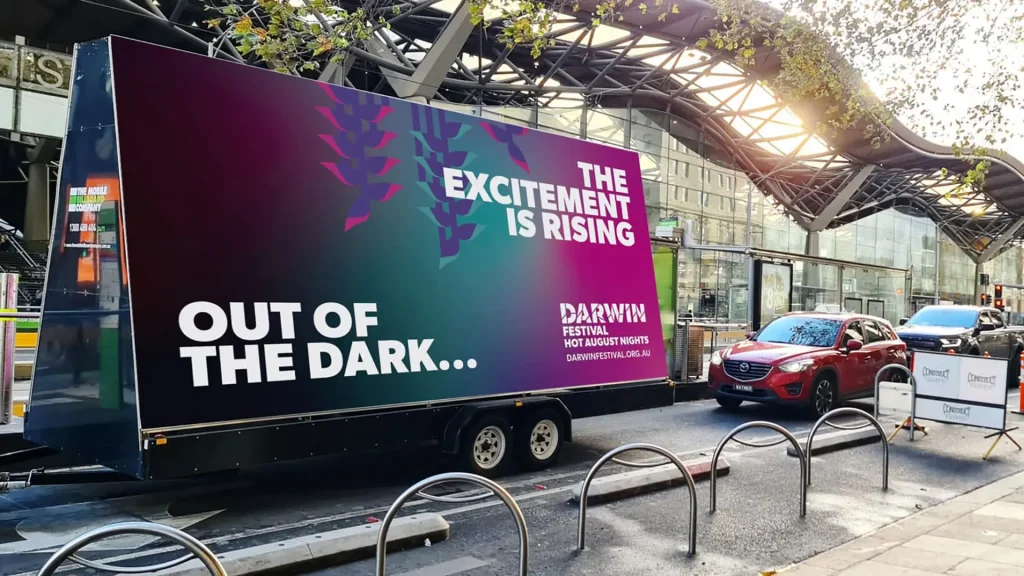
Brands use real-time bidding (RTB) for mobile digital OOH campaigns by purchasing ad placements on mobile billboard advertising trucks and LED screens through automated platforms that match audience data, location, and timing to available inventory. This programmatic approach replaces manual booking with flexible, data-driven buying that adjusts in real time based on campaign performance and audience movement.
At Moving Media, we’ve seen this shift accelerate firsthand. The global programmatic DOOH (Digital Out-Of-Home) platform market is projected to grow from $5.84 billion in 2025 to $6.83 billion in 2026 at a 17% compound annual growth rate. In Australia alone, the digital OOH market reached USD 474.2 million in 2025 and is forecast to more than double to USD 1,096.9 million by 2034, growing at a 9.47% CAGR. We work with brands across Australia who are already making this transition, and the results speak for themselves.
In this post, we explain how real-time bidding works for mobile digital OOH, why it outperforms traditional buying methods, and what we recommend Australian brands consider before launching a programmatic mobile billboard advertising campaign.
What Is Real-Time Bidding in Mobile Digital OOH
Real-time bidding is an automated auction process where advertisers bid for ad space on digital screens, including mobile billboard advertising trucks, within milliseconds. Instead of committing to fixed placements weeks or months in advance, brands set targeting parameters (audience demographics, location, time of day, weather triggers) and let the platform bid on their behalf whenever matching inventory becomes available.
For mobile digital OOH specifically, RTB connects demand-side platforms (DSPs) used by advertisers with supply-side platforms (SSPs) that manage screen inventory on mobile trucks and trailers. The transaction happens in real time, meaning ad content can change based on where our trucks are, who the surrounding audience is, and what conditions exist at that moment.
How the RTB Process Works for Mobile Billboard Advertising
The programmatic buying process for mobile digital OOH follows a structured sequence, though the entire cycle happens in fractions of a second. Here’s how we see it work across our campaigns.
Step-by-Step Breakdown
- Campaign Setup: The advertiser defines targeting criteria through a DSP. This includes audience segments, geographic zones, time windows, budget caps, and any contextual triggers such as weather or event proximity.
- Inventory Signal: As one of our mobile billboard advertising trucks enters a defined zone or reaches an audience threshold, the SSP sends an available impression signal to connected DSPs.
- Auction: Multiple advertisers bid simultaneously for that impression. The highest bid that meets the targeting criteria wins.
- Ad Delivery: The winning creative is pushed to our mobile digital OOH screen instantly. The ad displays while the truck is in the relevant zone or until the next auction cycle.
- Measurement: Impression data, location analytics, dwell time, and audience composition are logged in real time and fed back to the advertiser’s dashboard.
This cycle repeats continuously throughout the campaign, creating a dynamic system where every impression is individually evaluated and purchased based on its value to the brand at that specific moment.
How Measurement Changes With Programmatic Mobile Billboard Advertising
Traditional outdoor measurement relied heavily on estimated traffic counts and modeled exposure. Programmatic mobile digital OOH fundamentally changes that equation, and it’s one of the reasons we invested in building our own measurement capability.
Research from the OAAA and Harris Poll found that 76% of viewers took action after seeing a DOOH ad, and that consumers rank digital out-of-home more favorably than television, social media, and online display advertising. Separately, aided ad recall for DOOH reaches around 82%, confirming that digital formats don’t just get seen, they get remembered. When that exposure happens on one of our mobile billboard advertising trucks using programmatic buying, every one of those interactions becomes measurable. That’s the shift we’re focused on: turning outdoor advertising into a verified performance channel, not a branding gamble.
Real-Time Bidding vs. Traditional OOH Buying
For brands evaluating whether to shift toward programmatic mobile digital OOH, understanding the practical differences matters. Here’s how we break down the comparison for our clients.
| Factor | Traditional OOH Buying | RTB / Programmatic Mobile OOH |
| Booking Lead Time | Weeks to months in advance | Same day or within hours |
| Contract Length | Fixed 4-12 week minimums | Flexible, impression-based |
| Targeting | Location-based only | Audience, context, weather, time |
| Creative Changes | Costly, requires reprinting | Instant, automated via DCO |
| Measurement | Estimated traffic counts | Verified impressions, real-time data |
| Budget Control | Fixed spend, limited adjustment | Dynamic allocation based on performance |
| Optimisation | Post-campaign analysis only | Continuous, mid-campaign adjustments |
This comparison reflects why the broader industry is accelerating toward programmatic formats. As we outlined in our blog on why billboard advertising is evolving from static to mobile impact, the mobile digital billboard market is projected to grow at a 9.2% CAGR through 2034. Programmatic buying is a core driver of that growth, and it’s a shift we’re helping our clients navigate every day.
How We Support Programmatic Mobile Billboard Campaigns
At Moving Media, we don’t position programmatic as a buzzword. We build our mobile digital OOH campaigns around measurable outcomes, not assumptions. With over 25 years of experience in mobile billboard advertising across Australia, we combine physical mobility with data-driven strategy.
Our campaigns are powered by the Mobilytics platform, which tracks live impressions, audience heat maps, and post-exposure behavior. This data feeds directly into campaign optimization, allowing us to adjust routes, swap creative, and reallocate budgets based on verified performance rather than estimated traffic.
We also run every campaign carbon neutral through our partnership with Reforest. We calculate emissions across our operations and offset them through verified local reforestation projects. Our clients can track trees planted and CO₂ offset in real time through their dashboards. It’s how we ensure high-impact mobile billboard advertising aligns with long-term environmental responsibility.
When brands choose to work with us, they deal directly with our founder, Mick Diffey. One call, one solution, maximum results. Get in touch to plan your campaign.
Frequently Asked Questions
How quickly can campaigns go live using mobile digital OOH with RTB?
Campaigns using real-time bidding can launch within hours or even the same day. Unlike traditional outdoor advertising that requires long booking cycles, mobile digital OOH allows brands to activate campaigns almost instantly once targeting and budget parameters are set.
Can ads be updated during a mobile billboard advertising campaign?
Yes, creatives can be updated in real time. Advertisers can modify messaging, visuals, or offers instantly based on performance data, location changes, or external triggers like weather and events without any additional production costs.
What types of targeting are possible with programmatic mobile billboard advertising?
Programmatic mobile billboard advertising enables advanced targeting, including audience demographics, geographic zones, time of day, weather conditions, and proximity to events or high-traffic areas, ensuring ads reach the most relevant viewers.
Is mobile digital OOH suitable for performance-driven campaigns or only branding?
Mobile digital OOH supports both branding and performance campaigns. With real-time analytics such as impressions, dwell time, and audience engagement, brands can track outcomes and optimize campaigns for measurable results.
How do brands control spending in real-time bidding campaigns?
Brands can set daily budgets, bid limits, and targeting rules within their DSP. The system automatically allocates spend to high-performing impressions, ensuring efficient budget utilization and minimizing waste.
