
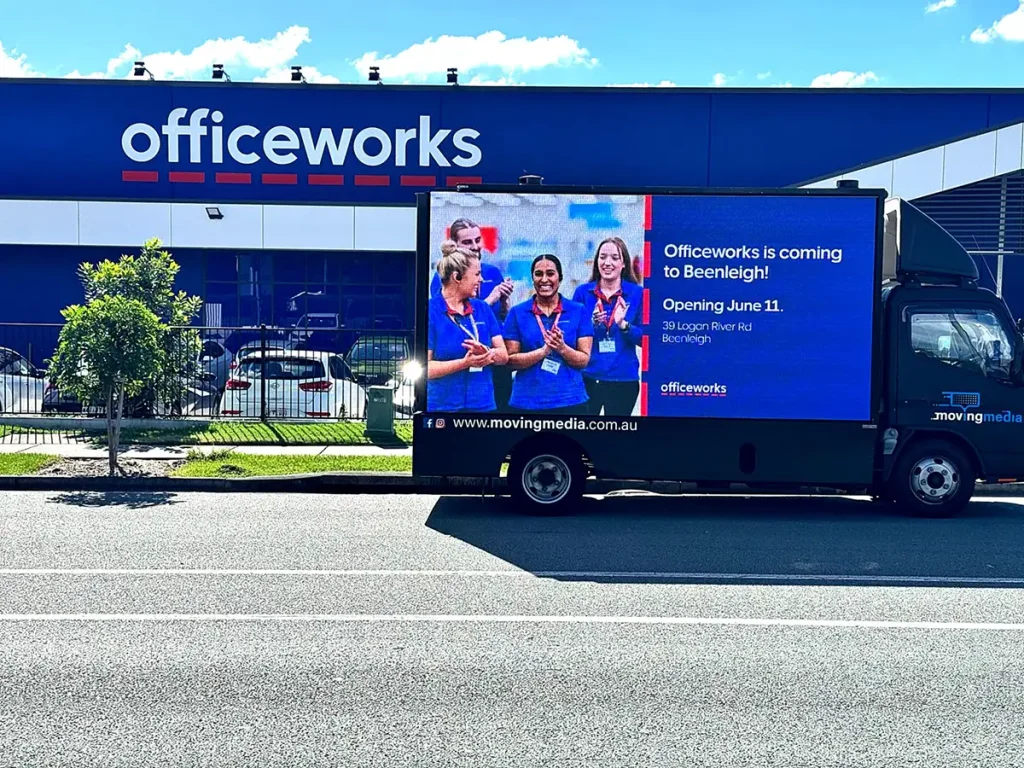
Every brief I get at Moving Media eventually lands on the same question: does this stuff actually work? Walking advertisements move at three kilometres an hour through a Pitt Street lunch crowd. Advertising on wheels rolls past 30,000 cars an hour on the M1.
Both formats sit at the human end of out-of-home, where the audience can almost reach out and touch the message. After 25 years running mobile OOH for brands like Uber Eats, Budget Direct, and Victoria Police, I can tell you the data backs them, but only when the format matches the brief. Here is what the latest numbers say, what they cost, and when each one earns its keep.
What the Latest 2026 Data Says About Walking Ads and Advertising on Wheels
The Australian outdoor sector is growing fast. The Outdoor Media Association recorded $1.4 billion in net media revenue in 2025, up 11.43% on the prior year, with digital out-of-home now driving 76.6% of that spend. Inside that growth, the formats most people remember are not the static towers above the motorway. They are the ones that come to you.
Three numbers tell the story:
- 97% ad recall: According to research summarised by AdQuick, advertising on wheels (mobile billboard trucks and trailers) achieves up to 97% recall, far higher than the 80 to 85% recall seen on quality static formats.
- 2.5x more effective than fixed billboards: Perception Research found vehicle advertising is 2.5 times more effective than fixed billboard advertising at driving message uptake.
- 15x stronger name recognition: The European Outdoor Advertising Association reports mobile formats lift brand name recognition. 15 times more than other advertising methods.
Walking advertisements (sandwich boards, illuminated backpack billboards, sign-walking street teams) sit alongside this. Their advantage is not just visibility but proximity. Most walking-board operators position their staff at eye level on busy footpaths, which removes the windscreen barrier that even the best roadside board cannot beat.
Walking Advertisement vs. Advertising on Wheels: Side-by-Side
Both formats fall under mobile OOH, but they solve different problems. Here is how they actually compare on the metrics that move budget.
| Factor | Walking Advertisement | Advertising on Wheels | Static Billboard |
| Typical day rate (AU) | $300–$800 per walker | $1,500–$3,000 per truck | $70–$700/day equivalent |
| Daily impressions | 3,000–8,000 (foot traffic) | 80,000–650,000+ | 30,000–250,000 |
| Ad recall rate | High (face-to-face) | Up to 97% | 80–85% |
| Geo-targeting | Hyper-local (block-level) | Suburb to state-level routes | Fixed location only |
| Best use case | Activations, sampling, CBD events | Launches, match days, regional tours | Always-on brand presence |
| Speed to market | 3–5 days | 7–14 days | 4–8 weeks |
| Measurement | Smart-sign sensors, flyer counts | Mobilytics, GPS, retargeting pools | MOVE 2.0 panel data |
Sources: Outdoor Media Association industry revenue, Signs.com 2026 billboard statistics, and Moving Media campaign benchmarks.
Why Walking Advertisements Punch Above Their Outdoor Advertising Cost
A walking advertisement is the cheapest mobile OOH format you can put on the market in Australia, often coming in under $800 per walker per day fully loaded. That sounds low until you remember what you actually get: a human at street level, eye-to-eye with shoppers, who can hand over a sample, scan a QR code, or answer a question. No other channel does that for the price.
Where they win:
- CBD lunch and after-work activations where foot traffic is dense and dwell times are long enough to register a message.
- Event perimeters (sports, festivals, conferences) where vehicles cannot park but a moving sign legally can.
- Sampling and lead capture campaigns. A walker handing out 800 flyers a day with a 12% scan rate beats most digital impression-cost benchmarks on a cost-per-engagement basis.
Where they fall short: scale. A team of six walkers might generate 20,000 to 40,000 face-level impressions per day. A single mobile LED truck on the same brief can deliver more than 200,000. If the campaign is national or needs reach across multiple suburbs in a week, walking ads are an add-on, not the spine.
Why Advertising on Wheels Now Wins the Reach Conversation
Advertising on wheels covers the formats with engines: mobile digital trucks, printed mobile trailers, solar LED trailers, and branded utility vehicles. At Moving Media, this category has had the fastest growth in Australian OOH for three reasons: measurement, targeting, and unbeatable share of voice.
Most fixed digital boards rotate six to ten advertisers in a loop, meaning you own roughly 10 to 16% of screen time. A mobile truck carries only your message, giving you 100% share of voice for every metre it travels. That is one of the few places in the modern media ecosystem where you can still buy uncontested attention.
Recent campaigns Moving Media has run show what that translates to in practice:
- Cricks Motor Group ran one digital truck through Brisbane and the Sunshine Coast for a one-day sale and recorded 650,000 impressions, all of which fed into a post-campaign retargeting pool.
- A three-day Uber Eats regional launch across 10 Australian and New Zealand towns delivered 180,240 geo-targeted impressions tied to QR-code scans.
These are not estimates. Both campaigns were measured through the Mobilytics platform, which captures every device that comes within sensor range and lets you retarget those same audiences afterwards on digital channels. That closed-loop measurement is what has dragged mobile OOH into the same media-planning conversation as paid social and CTV.
Outdoor Advertising Cost Reality Check: What You Actually Pay in 2026
Pricing varies wildly across formats and cities. For a complete breakdown of how every Australian OOH format prices up, read our guide on how much billboard advertising costs and what affects the price. A snapshot of the mobile end of the market:
- Walking advertisement teams: $1,500 to $4,000 per day for a 4- to 6-person crew, including LED-illuminated boards and flyer distribution.
- Printed mobile trailers: $400 to $1,200 per day, ideal for budget-conscious local campaigns.
- Solar LED trailers: $600 to $1,800 per day, with the lowest carbon footprint of any digital OOH option.
- Mobile digital truck: $1,500 to $3,000 per day, covering several suburbs in a single shift.
Compare that to a static billboard at $5,000 to $15,000 per four-week cycle, and the per-impression maths often favours the mobile formats, especially when measurement is included in the rate card. Every Moving Media booking includes Mobilytics reporting in the day rate, so the comparison gets even sharper once you factor in the post-campaign retargeting pool you walk away with.
So, Do They Work? Here is the Honest Answer
Yes, with one condition: the format has to match the campaign objective. Use this simple decision tree:
- Need brand awareness across a city for four weeks straight? Static billboards still earn their place.
- Launching a product, running an event, or pushing a regional retail promotion? Advertising on wheels delivers higher recall, faster setup, and measurable post-campaign retargeting.
- Activating a CBD pop-up, sampling a new product, or owning a sports precinct on game day? Walking advertisements deliver street-level engagement no other format matches.
The brands that get the best return are the ones that stack formats. A digital truck moves through the city while walking boards activate the destination. The truck delivers the impressions; the walkers deliver the conversion. Layered correctly, the recall numbers compound: a consumer who sees your truck on the morning commute and then encounters a walking advertisement at lunch has been exposed to the same creative twice in different contexts, which is the strongest known driver of unaided brand recall in OOH research.
The other thing the data confirms: measurement closes the loop. The reason advertising on wheels has overtaken static formats in growth share is not just the moving-vehicle attention bump. It is that mobile OOH can now be tied to outcomes in the same dashboard as your paid media. When your CFO asks what the campaign returned, you can show route data, unique device IDs in the retargeting pool, and uplift in branded search, all from one report. That changes the conversation from ‘we hope it worked’ to ‘here is what it delivered.’
Frequently Asked Questions
How much does outdoor advertising cost in Australia?
Outdoor advertising costs in Australia range from $400 per day for a printed mobile trailer to over $100,000 per four-week cycle for a Sydney CBD landmark static billboard. Most mobile OOH campaigns Moving Media activates land between $1,500 and $3,000 per day for a fully measured digital truck. Mobile formats typically deliver a lower CPM than equivalent metro static placements once measurement is included.
What is a mobile billboard, and is it the same as advertising on wheels?
A mobile billboard is any large-format advertisement mounted on a moving vehicle, including digital LED trucks, vinyl-wrapped trailers, and solar LED units. Advertising on wheels is the broader category covering all of these formats. Unlike fixed roadside billboards, mobile billboards travel routes you choose, giving you 100% share of voice and access to event precincts and stadium perimeters fixed inventory cannot reach.
How effective is outdoor advertising compared to digital ads?
Highly effective. Mobile OOH formats achieve up to 97% recall, while traditional digital phone ads typically retain only 12% of viewers per Transport Advertising Council research. Outdoor advertising reaches 97% of Australians weekly per Roy Morgan, and adding OOH to a media plan lifts digital search reach by 40%. The strength of outdoor is unavoidability: no swipe, no skip, no ad blocker.
How does outdoor advertising work for small or regional businesses?
Outdoor advertising works for smaller advertisers when the format matches the catchment. A walking advertisement crew suits a CBD launch or a single-suburb activation. A printed mobile trailer at $400 to $1,200 per day fits a regional retailer wanting visibility for a week. Moving Media regularly runs mobile OOH for local launches and event-based campaigns where a fixed billboard buy would be wasteful.
How much does mobile billboard advertising cost per day?
Mobile billboard advertising costs $400 to $1,200 per day for printed trailers, $600 to $1,800 for solar LED trailers, and $1,500 to $3,000 for full digital LED trucks across Australian metro markets. Multi-day and multi-truck bookings unlock lower effective day rates, and every Moving Media campaign includes Mobilytics tracking in the day rate with no add-on fees.
Plan Your Mobile OOH Campaign with Moving Media
If walking advertisements or advertising on wheels could fit your next campaign, the fastest way to find out is to talk it through with the Moving Media team. Call Mick directly on 0417 848 150, or use the contact form for a tailored quote within one business day. You can also request a Mobilytics sample report to see exactly what the post-campaign data looks like before you commit a dollar.
