
Billboard advertising has always relied on one simple goal: be seen. For decades, that visibility depended on scale, height, and traffic flow. A large printed panel placed along a busy road could dominate a skyline and repeat a message thousands of times a day.
But visibility has changed.
Today, audiences move faster, divide their attention across devices, and expect messages to feel timely and relevant. Static formats still exist, yet digital billboard advertising and LED billboard advertising have redefined what “being seen” actually means.
At Moving Media, we’ve watched this evolution firsthand. The shift isn’t about replacing traditional structures for the sake of novelty. It’s about transforming billboard advertising from passive exposure into measurable, dynamic engagement.
Let’s look at how.
From Static Presence to Dynamic Impact
Traditional billboard advertising offered permanence. A fixed structure delivered repetition through daily commuter traffic. That repetition built brand recall, especially for national advertisers.
However, permanence also meant rigidity:
- Creative stayed unchanged for weeks or months
- Messaging could not respond to events or timing
- Performance measurement relied on estimated traffic counts
Digital billboard advertising introduced flexibility. Instead of printed vinyl, LED screens display rotating content that can be updated instantly. This change alone reshaped visibility.
Now, brands can shift messaging based on:
- Time of day
- Weather conditions
- Event schedules
- Campaign performance
Why LED Billboard Advertising Commands Attention
LED billboard advertising enhances brightness, clarity, and motion. Unlike traditional printed panels, LED displays:
- Deliver high-resolution imagery
- Use animation and subtle motion
- Maintain clarity in low light or harsh daylight
- Rotate multiple advertisers within the same placement
Human attention naturally responds to movement and contrast. LED formats leverage that behavioural principle. Even small animated elements can increase noticeability compared to static visuals.
Research across digital out-of-home (DOOH) channels shows digital screens capture significantly more attention than printed boards because motion interrupts visual autopilot. In crowded urban environments, that interruption matters.
Real-Time Visibility Is the New Standard
One of the most significant ways digital billboard advertising changes visibility is through real-time adaptability. Campaigns can launch quickly, pivot mid-flight, or respond to performance signals. If a message underperforms, creative can be swapped within hours rather than weeks.
At Moving Media, we combine LED billboard advertising with mobility. Our digital trucks and solar LED trailers move through peak-density areas, adjusting routes to match audience flow. That mobility transforms visibility from location-dependent to audience-dependent. Instead of asking, “Will the audience pass this billboard?” we ask, “Where is the audience right now?”
Data Turns Visibility Into Measurable Performance
Traditional billboard advertising relied on estimated exposure, often based on traffic counts to gauge how many people might see a billboard. However, digital advertising changes this approach. Through our partnership with Mobilytics, Moving Media now captures real-time opportunity-to-see impressions. When devices come within range of our LED displays, sensors record anonymised exposure data.
Our dashboard updates every minute, showing:
- Location density
- Time-of-day engagement
- Unique impressions
- Route performance
Clients receive comprehensive post-campaign reports featuring satellite mapping and identifying peak engagement periods. Visibility is now measurable rather than speculative.
Stronger Recall Through Motion and Rotation
Digital billboard advertising increases recall through movement and repetition across varied environments. Studies consistently show digital formats outperform static displays in recall rates. Motion increases cognitive processing, while rotating creativity maintains freshness. LED billboard advertising also allows sequential storytelling. Instead of one static message, brands can deliver:
- Introductory frames
- Call-to-action slides
- Location-based prompts
- QR code engagement
This layered approach enhances message retention. In recent Moving Media campaigns, clients have achieved up to 650,000 impressions per activation. Achieving visibility at this scale, coupled with measurable engagement, transforms how outdoor media performs within a broader marketing strategy.
Integration With Digital Ecosystems
Another major shift is integration. Digital billboard advertising now aligns with online campaigns through retargeting. Exposure data can feed into digital mobile ads, reinforcing brand presence after initial physical visibility.
This creates a loop:
- The audience sees the LED billboard.
- Device data captures an exposure opportunity.
- Follow-up digital ads appear later.
The physical and digital environments no longer operate separately. For brands accustomed to programmatic buying online, this integration makes billboard advertising feel familiar rather than disconnected.
Case Studies That Illustrate the Shift
The transformation from static to LED billboard advertising becomes clearer through real-world examples. Uber Eats deployed mobile digital assets across 10 regional towns in Australia and New Zealand. In just three days, the campaign delivered over 180,000 impressions with geo-targeted QR engagement.
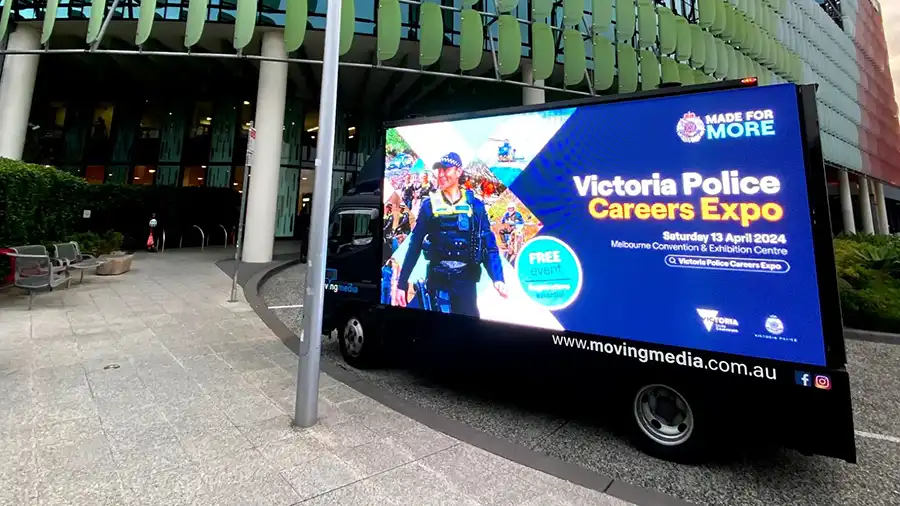
Cricks Motor Group activated a mobile-targeting digital truck campaign across Brisbane and the Sunshine Coast, generating 650,000 impressions to support a one-day dealership sale. Victoria Police leveraged LED billboard advertising within Melbourne CBD to promote a recruitment expo, measuring web traffic and consumer behaviour as KPIs. These campaigns relied on adaptability and measurable reach, not fixed placements alone.
Geographic Flexibility Expands Reach
Static billboard advertising remains limited by zoning and infrastructure. LED billboard advertising, combined with mobility, dramatically expands geographic reach. Moving Media campaigns have travelled more than 21,000 kilometres in a single activation. This allows brands to:
- Target metro centres
- Reach remote regions
- Activate around events
- Test emerging suburban markets
From Australia and New Zealand to the UK, Europe, and North America, mobility enables brands to connect with audiences that would otherwise be unreachable. Visibility becomes more dynamic rather than static.
Sustainability and Modern Media Responsibility
Digital transformation also intersects with environmental responsibility. At Moving Media, every campaign operates carbon-neutral through our partnership with Reforest. We calculate emissions from operations and offset them through verified reforestation projects across Australia.
Clients can access a real-time dashboard tracking:
- Trees planted
- CO₂ offset
- Project locations
LED billboard advertising also reduces material waste associated with printed vinyl production and replacement cycles. Modern visibility must align with sustainability goals. Digital formats make that possible without sacrificing performance.
Programmatic Buying and AI Optimisation
Technology continues to advance digital billboard advertising. AI-driven optimisation tools enable route planning and time-slot selection to adapt to data. Real-time bidding systems enable premium placements during high-impact windows. Campaigns evolve daily, sometimes hourly, rather than remaining static for weeks at a time. This shift aligns billboard advertising with the broader digital marketing environment where brands expect continuous optimisation.
Where Static Still Fits
Despite advancements in advertising, traditional billboard advertising still retains its value in specific contexts. Long-term brand reinforcement along established commuter routes can provide a reliable presence.
Additionally, static placements may have lower upfront costs for extended campaigns. However, the outdoor advertising market is increasingly seeing growth in digital and LED formats. Global projections indicate that mobile and digital advertising will continue to expand over the next decade. The focus has shifted toward flexibility in visibility.
The Moving Media Approach
At Moving Media, we position LED and digital billboard advertising not as standalone solutions but as integrated components of a mobile OOH strategy.
We handle:
- Creative planning
- Route optimisation
- Real-time tracking
- Retargeting integration
- Post-campaign reporting
Clients work directly with our founder. No middlemen. No delays. Our goal is simple: make visibility measurable, adaptable, and impactful.
The Future of Billboard Advertising
Visibility used to rely solely on size, but today it depends on adaptability, movement, and data. Digital billboard advertising offers flexibility, while LED billboard advertising captures attention more effectively. Mobility ensures that messages remain relevant, and data validates their performance.
Billboard advertising is no longer just about being stationary on a highway; it’s about engaging with audiences, responding to their context, and demonstrating impact. As cities evolve and attention spans shorten, the advertising formats that enhance visibility are those that refuse to remain static. This is what distinguishes modern outdoor advertising.
Frequently Asked Questions
How does digital billboard advertising improve visibility compared to traditional billboard advertising?
Digital billboard advertising improves visibility by leveraging motion, brightness, and rotating content to capture attention more effectively than static print ads. Unlike traditional billboard advertising, digital formats allow real-time updates, daypart targeting, and adaptive messaging. This flexibility helps brands stay relevant and increases audience recall in fast-moving urban environments.
What is the difference between LED billboard advertising and digital billboard advertising?
LED billboard advertising refers to the use of high-resolution LED screens to display content. In contrast, digital billboard advertising describes the broader strategy of using dynamic, changeable content on those screens. LED technology powers the visuals, while a digital strategy enables scheduling, rotation, animation, and data integration to deliver measurable results.
Can LED billboard advertising support measurable campaign performance?
Yes. LED billboard advertising can integrate with real-time data platforms to measure opportunity-to-see impressions, dwell times, and audience density. When paired with analytics tools like Mobilytics, brands receive detailed reporting and post-campaign insights, transforming billboard advertising from estimated exposure into trackable performance metrics.
Is digital billboard advertising suitable for short-term campaigns?
Digital billboard advertising works well for short-term activations because creatives can launch quickly and adjust in real time. Brands promoting events, retail sales, or product launches benefit from the flexibility to rotate messaging, shift locations, and optimise exposure during peak audience periods.
How does LED billboard advertising support sustainability goals?
LED billboard advertising reduces the need for printed materials and allows longer-lasting digital creative updates. When combined with carbon-neutral operations and emission-offset partnerships, as implemented by Moving Media, campaigns can align strong visibility with environmental responsibility and transparent sustainability reporting.
