
Advertising, What Options Stand Out?
Searching for billboards advertising today no longer leads to a single, predictable solution. It used to. For decades, outdoor advertising meant booking a fixed roadside structure, uploading creative, and waiting for passing traffic to do the rest.
That model worked when movement patterns were stable, and performance expectations were simpler. But audiences now split attention across devices, commute in shifting patterns, and expect relevance. At the same time, marketing teams demand measurable outcomes rather than projected estimates.
So when businesses search for billboard advertising today, what actually stands out? The answer depends on flexibility, accountability, and performance, not just size or location.
Static Advertising Billboards: Still Familiar, But More Limited
Traditional advertising billboards remain visible across highways and major arterials. Their value lies in permanence. A fixed site in a high-traffic corridor can deliver steady exposure over time. For long-term brand awareness, this consistency still has a place. Large national brands often use static placements to reinforce recognition across months rather than days.
However, permanence now comes with constraints. Traffic flows fluctuate. Urban construction alters sightlines. Events shift audience density. A fixed location cannot respond to these variables. Creative cannot change instantly. Measurement relies heavily on historical traffic modelling instead of real-time behavioural data. For businesses evaluating billboard advertising options, those limitations matter more than they once did.
Digital Billboard Advertising: A Necessary Evolution
Digital billboard advertising introduced motion, flexibility, and scheduling precision. LED screens rotate multiple brands and allow creatives to shift by time of day or campaign phase.
This alone changed how businesses evaluate outdoor media. Instead of printing and installing vinyl for extended contracts, advertisers can now:
- Update messaging remotely
- Rotate creative variations
- Daypart-specific offers
- Launch campaigns faster
Digital screens also create stronger visual contrast, capturing attention through motion rather than solely through scale. For many brands, digital billboard advertising becomes the first step away from purely static placements. But while digital fixed screens improve flexibility, they still rely on a single geographic point. The audience must come to them.
Mobility Changes the Equation
The real shift happens when campaigns move. Mobile billboard advertising removes the dependence on fixed infrastructure. Instead of waiting for audiences to pass through a structure, campaigns travel through peak-density zones when attention is at its highest. At Moving Media, businesses are increasingly focusing their investments here.
Mobile assets can shift from CBD congestion in the morning to retail corridors in the afternoon and event precincts at night. Instead of locking into one suburb, brands follow audience behaviour throughout the day. That adaptability is what often makes mobile options stand out when businesses compare billboard advertising formats side by side.
Why Performance Now Drives Decisions
Outdoor advertising used to be measured by reach potential. Today, brands want verified exposure. Through our partnership with Mobilytics, Moving Media tracks opportunity-to-see impressions in real time. Our dashboard updates every minute, capturing location data and device density near our HD LED screens.
Clients receive post-campaign reports showing:
- Unique impressions
- Busiest exposure windows
- Satellite route mapping
- Retargeting opportunities
This turns outdoor from a branding gamble into a measurable performance channel. When businesses search for billboard advertising solutions now, they increasingly prioritise formats that provide evidence rather than estimates.
The Case for Hybrid Strategies
In many campaigns, the strongest option is not a single format but a layered approach. Static placements can reinforce long-term presence. Digital billboard advertising can provide creative rotation. Mobile assets can activate high-intensity bursts around events or retail spikes.
Recent Moving Media campaigns illustrate this well. Uber Eats deployed both mobile and static assets across regional Australia and New Zealand, generating over 180,000 impressions in just three days. Cricks Motor Group used a mobile digital truck activation for a one-day dealership sale, delivering 650,000 impressions and enabling post-campaign digital retargeting. These outcomes reflect strategic selection, not default booking.
Geographic Flexibility as a Competitive Edge
One of the clearest reasons mobile formats stand out is their reach beyond fixed infrastructure. Static advertising billboards depend on zoning and council approvals. Mobile units operate within compliant frameworks but can move across multiple suburbs and regions within a single activation.
Moving Media campaigns have travelled more than 21,000 kilometres in a single deployment. That level of geographic fluidity allows brands to test, refine, and scale campaigns without relocating physical structures. The shift to evidence-led buying is an exciting development highlighted in why billboard advertising is evolving from static to mobile impact, where verified exposure is transforming the calculation of value in innovative ways.
Real Campaign Examples Across Industries
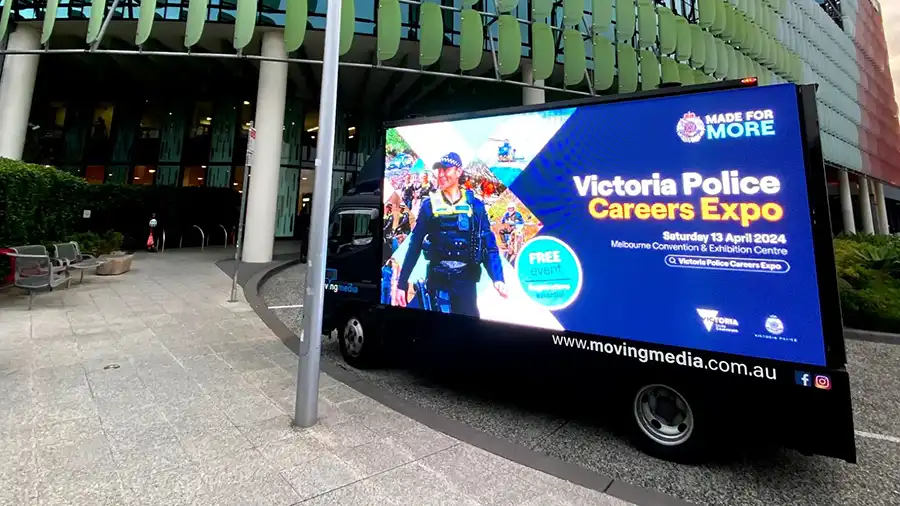
We have worked across more than ten industries, from government to retail to education. Victoria Police used mobile digital trucks in Melbourne CBD to promote recruitment initiatives, aligning route targeting with behavioural metrics. Budget Direct activated around Suncorp Stadium to engage NRL fans, measuring impressions through Mobilytics data.
The University of the Sunshine Coast used mobile targeting modes to drive attendance at open days. In each case, mobility-aligned messaging aligned with audience movement rather than fixed-placement assumptions. Up to 650,000 impressions per activation is not unusual in high-density environments.
Sustainability Now Influences Media Choice
At Moving Media, every campaign runs carbon neutral through our partnership with Reforest. We calculate emissions from operations and offset them through verified reforestation projects.
Clients can access dashboards showing trees planted and CO₂ offset in real time. For brands balancing performance goals with ESG commitments, sustainability becomes another reason mobile OOH stands out. Outdoor advertising should not come at the expense of environmental responsibility.
The Role of Technology in Modern Billboard Advertising
Technology continues to push the channel forward. Energy-efficient LED displays improve visibility. AI-assisted optimisation supports route planning. Real-time analytics align exposure windows with audience peaks. Mobile units also integrate QR codes and call-to-action prompts that connect physical visibility with digital follow-through.
Instead of passive exposure, campaigns generate measurable responses. As technology advances, digital billboard advertising and mobile formats increasingly operate like extensions of digital marketing channels rather than traditional static media.
What Businesses Prioritise Now
When clients approach Moving Media, their conversations rarely focus solely on size or location.
They ask about:
- Real-time tracking
- Flexible deployment
- Audience precision
- Retargeting capability
- Carbon neutrality
This shift reflects a broader change in marketing expectations. Visibility alone is not enough. Accountability defines value.
Choosing the Right Billboard Advertising Format
Not every campaign requires the same structure. Static billboards may still suit long-term presence in predictable corridors. Digital fixed screens add flexibility and creative variation. Mobile billboard advertising introduces agility and data-led optimisation.
For many brands, mobility becomes the differentiator because it responds to movement patterns rather than assuming them. When businesses search for billboard advertising solutions today, the options that stand out are those that move with the audience, provide measurable insight, and adapt in real time.
Moving Forward With Confidence
Billboard advertising has transformed from a focus on fixed repetition to a flexible, performance-driven approach. At Moving Media, we leverage over 25 years of marketing expertise, data-driven execution, and personalised service. We deliver campaigns throughout Australia and internationally, managing logistics in-house and providing transparent reporting from activation to completion. We view mobile out-of-home advertising not as a novelty but as a strategic response to current mobility trends. In a market characterised by movement, the billboard formats that truly stand out are those that embrace it.
Frequently Asked Questions
How do mobile billboard advertising options compare to static billboards?
Mobile billboards advertising solutions move through high-traffic areas instead of relying on a fixed location. This allows brands to target peak zones, events, and retail corridors in real time. Static billboards provide consistent, long-term visibility, but mobile formats often offer greater flexibility and measurable engagement.
Is digital billboard advertising more effective than traditional formats?
Digital billboard advertising typically captures more attention due to motion, brightness, and rotating creative. It supports daypart scheduling and remote updates, improving campaign agility. While traditional advertising billboards still build brand presence, digital formats offer better adaptability and stronger integration with data tracking.
How is performance measured for modern advertising billboards?
Modern campaigns use real-time analytics tools to measure opportunity-to-see impressions, dwell times, and geographic exposure. With platforms like Mobilytics, brands receive detailed post-campaign reports that show audience density, route mapping, and engagement windows, rather than relying solely on projected traffic estimates.
Are mobile billboard campaigns suitable for smaller businesses?
Yes. Mobile billboard campaigns can scale to suit different budgets and timeframes. Businesses can run short-term activations in targeted suburbs or around specific events. This flexibility makes mobile options practical for local promotions without requiring long-term commitments often associated with fixed billboard placements.
Can billboard advertising support sustainability goals?
Yes. Many providers now operate energy-efficient LED assets and offer carbon-neutral campaigns. At Moving Media, we offset emissions through verified reforestation partnerships. This allows brands to align billboard advertising efforts with environmental responsibility while maintaining high-impact visibility.
