
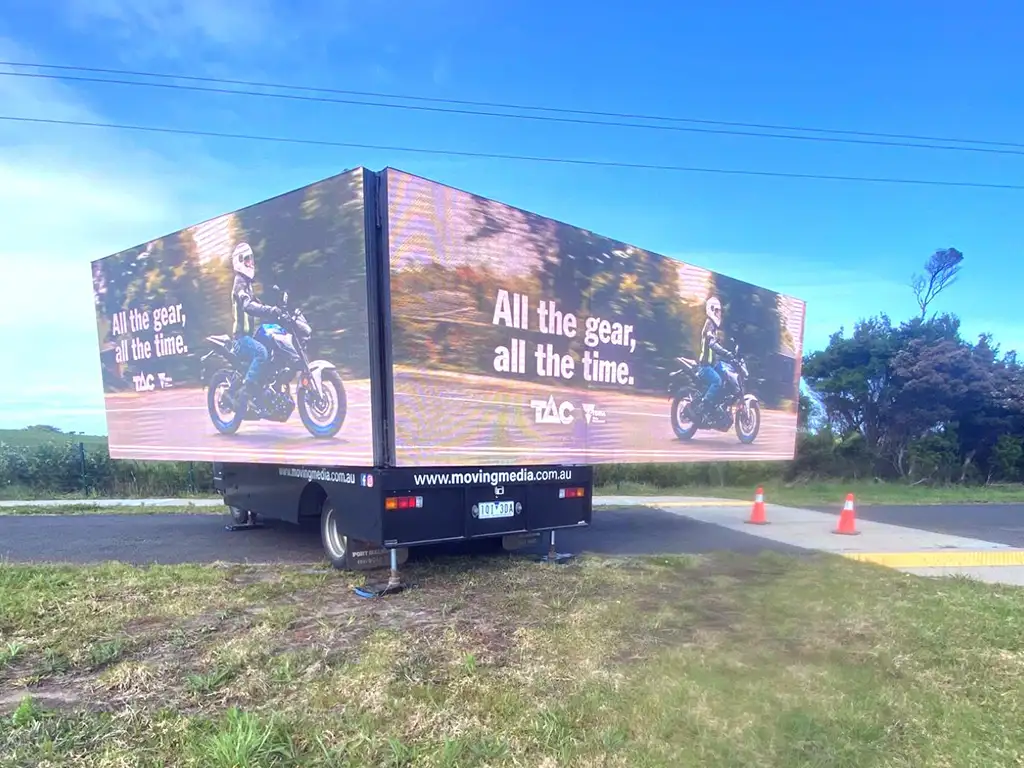
For decades, advertising billboards followed a familiar formula: fixed locations, long-term contracts, and exposure built on repetition. That model worked when audiences moved predictably, and attention stayed focused on the road ahead. Today, that reality has changed. Cities move faster, audiences split their attention across screens, and brands demand proof, not assumptions, of performance. At Moving Media, we’ve watched this change accelerate from the inside.
Static billboard advertising hasn’t disappeared, but it no longer carries the same weight it once did. Mobile formats, especially mobile billboard advertising delivered via a billboard truck, have stepped in to fill the gaps that static placements can’t address. This evolution isn’t driven by novelty. It’s driven by measurable outcomes, flexibility, and a demand for accountability that traditional formats struggle to meet.
Static billboards: Strong Foundations, Growing Limitations
Static billboards still offer value. Their strength lies in permanence. A fixed structure on a major arterial road can deliver consistent exposure over time. That stability explains why static formats still hold roughly 29.9% of the total billboard market share.
But permanence comes with trade-offs:
- Visibility depends on traffic patterns that no longer behave predictably
- Long-term contracts lock brands into locations that may underperform
- Creative can’t respond to weather, events, or real-time context
- Measurement relies heavily on modelled estimates rather than verified exposure
As urban density increases and consumer movement fragments, static placements often wait for audiences instead of meeting them where they actually are.
Why Mobile Billboard Advertising is Gaining Momentum
The global outdoor advertising market continues to grow from $41.2 billion in 2025 to a projected $78.1 billion by 2030, but nearly all that momentum sits with digital and mobile formats.
The mobile digital billboard market alone reached USD $32.5 billion in 2024 and is projected to climb to $78.4 billion by 2034, driven by a 9.2% CAGR. This growth reflects a simple truth: mobility matches how people live now. Mobile billboard advertising allows campaigns to move through:
- CBD congestion during peak hours
- Event precincts before and after activations
- Retail corridors when foot traffic spikes
- Suburban zones, static billboards rarely reach
Instead of hoping audiences pass a fixed point, mobility follows audience behaviour in real time.
Performance Metrics Driving The Shift
The strongest argument for mobile impact comes from performance data. Across global and local campaigns, digital and mobile billboards consistently outperform static formats.
Key differences include:
- 2.5× more attention captured by digital billboards compared to static ones
- 60% more impressions generated through animation and rotating creative
- Up to 400% higher engagement rates
- 83% brand recall for digital formats versus 65% for static displays
Even modest recall improvements, such as an 18% lift, can change campaign effectiveness at scale. When brands measure outcomes rather than impressions alone, these margins matter.
Mobile Billboard Advertising Trucks Change How Engagement Works
A mobile billboard advertising truck is not just a moving screen. It’s a dynamic media channel capable of interaction, optimisation, and response.
Modern campaigns integrate:
- QR codes that prompt immediate action
- Mobile search and web traffic are tied to exposure windows
- Contextual messaging based on location or time of day
Industry data shows up to 25% of viewers engage further after seeing compelling digital billboard content. Static billboards rarely create this level of follow-through because they can’t link exposure to action.
Measurement Has Moved From Estimates To Evidence
One of the biggest limitations of traditional advertising billboards is measurement. Static formats rely on traffic counts and historical modelling. Mobile formats now operate in real time.
Through our partnership with Mobilytics, we track:
- Devices with the opportunity to see the message
- Location-based exposure patterns
- Dwell time and audience density
- Post-exposure movement and retargeting opportunities
Location analytics can show how many people passed a mobile billboard, later visited nearby stores, or searched for a brand after exposure. That level of insight turns outdoor advertising into a measurable performance channel rather than a branding gamble.
Programmatic and Data-Led Buying Reshape Outdoor Strategy
The rise of mobile and digital billboards has introduced capabilities once limited to online advertising:
- Real-time bidding on premium routes and time slots
- AI-driven performance optimisation
- Automated media buying with immediate adjustments
Campaigns no longer run unchanged for weeks. They evolve daily, sometimes hourly, responding to performance signals as they appear. This shift aligns outdoor media with the broader digital ecosystem brands already trust.
Cost Efficiency and Return on Investment
There’s a common misconception that mobile formats cost more. In reality, they often deliver stronger value over time.
Key ROI factors include:
- $5.97 return for every dollar spent on digital out-of-home advertising
- No ongoing printing or installation costs after setup
- Shared rotations allow multiple advertisers to use the same asset
- Campaigns that start small and scale based on results
While digital formats may carry higher upfront costs, they consistently outperform static billboards when cost is measured against verified engagement and outcomes.
Geographic Flexibility, Static Billboards Can’t Match
Static billboards are tied to zoning, permits, and fixed infrastructure. Mobile billboard advertising moves freely within approved frameworks, opening up coverage that static formats can’t access.
That flexibility enables:
- Multiple suburbs reached with a single unit
- Peak-time targeting across different locations in one day
- Deployment around pop-up events, launches, and seasonal demand
In growing cities and regional markets alike, this adaptability explains why mobile formats continue to gain share.
Technology is Pushing Mobile OOH Forward
The evolution from static to mobile impact is also powered by rapid technological progress:
- Energy-efficient LED displays with brighter, sharper imagery
- AI-powered optimisation tools that adjust routes and schedules
- Augmented reality integrations are creating immersive experiences
- Solar-powered units supporting sustainability goals
- Computer vision analytics is improving audience measurement
These advancements don’t just improve visibility; they improve accountability.
Sustainability Becomes Part of Media Planning
Environmental responsibility now factors into advertising decisions. Mobile OOH has responded with innovation rather than compromise. At Moving Media, every campaign runs carbon neutral through our partnership with Reforest.
We calculate emissions across operations and offset them through verified local reforestation projects. Clients can track trees planted and CO₂ offset in real time through dashboards. This approach aligns performance-driven advertising with long-term environmental responsibility.
Where Static Still Fits and Where it Falls Behind
Static billboards still play a role, particularly where regulatory familiarity and lower upfront costs matter. They work well for long-term brand presence in predictable corridors. But the market direction is clear. Digital and mobile formats grow faster, perform better, and integrate more effectively with modern marketing strategies. The 9.2% CAGR for mobile digital billboards through 2034 signals a structural shift, not a passing trend.
Mobile Impact Becomes The New Standard
The evolution from static billboard advertising to mobile impact reflects a broader change in how brands think about visibility. Mobile billboard advertising delivers on all four. At Moving Media, we don’t position mobile OOH as a replacement for every static placement.
We position it as the format built for how audiences move now. When brands choose mobility, they choose relevance, responsiveness, and results grounded in data, not guesswork. That’s why billboard advertising isn’t standing still anymore. It’s moving with the audience.
Frequently Asked Questions
How does mobile billboard advertising compare to traditional advertising billboards in effectiveness?
Mobile billboard advertising consistently delivers stronger performance metrics than static billboard advertising. Industry research indicates digital and mobile formats capture up to 2.5 times more attention and deliver significantly higher engagement and recall rates. Because mobile billboard advertising trucks move through high-traffic areas at peak times, brands reach audiences when they are most active rather than relying on fixed exposure patterns.
Is mobile billboard advertising suitable for both large brands and smaller businesses?
Yes. Mobile billboard advertising scales well across different budgets and campaign sizes. While large brands use it for nationwide launches, smaller businesses benefit from its flexibility and precise targeting. Campaigns can start with short runs, focus on specific suburbs or events, and expand based on measured results, making mobile formats accessible without long-term commitments.
How is performance measured for mobile billboard advertising trucks?
Performance measurement relies on real-time, location-based analytics rather than estimated traffic counts. Modern mobile billboard advertising trucks use sensor-based platforms to track opportunity-to-see impressions, dwell times, and movement patterns. This data allows brands to understand when and where exposure occurs and how audiences behave after seeing the message.
Why are digital and mobile billboards growing faster than static formats globally?
The global billboard market is seeing faster growth in the digital and mobile segments because they offer dynamic content, measurable results, and better integration with digital marketing. With the mobile digital billboard market projected to grow at a 9.2% CAGR through 2034, advertisers are prioritising formats that deliver flexibility, real-time optimisation, and stronger returns on investment.
Can mobile billboard advertising support sustainability goals?
Yes. Many mobile OOH providers now incorporate sustainability initiatives such as carbon-neutral operations and energy-efficient LED technology. At Moving Media, campaigns offset emissions through verified reforestation partnerships, allowing brands to run high-impact advertising while aligning with environmental responsibility and transparency expectations.
