
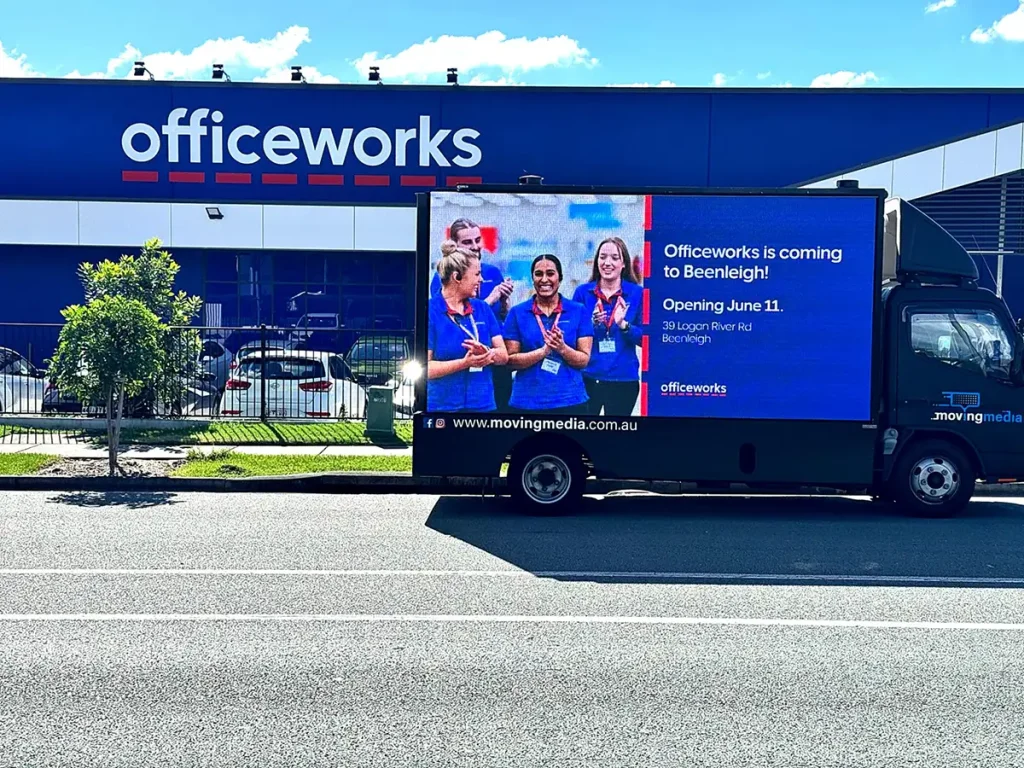
Outdoor advertising has always succeeded for one simple reason: it meets people where they actually go. On highways, in business districts, near shopping centres, and at events, billboards connect brands to audiences in real physical space. But in 2025, the conversation around billboard advertising prices has shifted. It’s no longer just about renting a panel; it’s about understanding the value of real attention.
At Moving Media, brands make better choices when they understand what they’re paying for. And the truth is: the cost of a billboard tells a story about the audience behind it, how many people move through an area, how engaged they are, and how relevant that environment is to the campaign.
Why Billboards Cost What They Cost
Four main signals shape the price of outdoor advertising:
- Where it’s located
- How do people move around that location
- What format is being used
- What type of attention does it generate
High-traffic intersections, event precincts, and busy commuter routes naturally carry higher pricing because they deliver more opportunities for impressions, not hypothetical traffic counts, but real-world exposure.
In 2025, pricing clearly illustrates this spectrum. While rural static billboards may start around $250/month, premium digital placements in high-demand metro environments can exceed $20,000–$50,000/month. Most markets sit somewhere in between:
- Regional static: $250–$1,500/month
- Suburban static: $1,000–$5,000/month
- Metro static: ~$10,000+
- Premium metro digital: $20,000+
The point isn’t that one is ‘better’, it’s that each delivers a different kind of value. A modest sign on a rural road can outperform a metro placement if it speaks directly to a tight local audience.
The Role of Mobile OOH in Today’s Pricing Landscape
A significant factor changing the pricing conversation is mobile OOH billboards that move with the audience. Instead of waiting for eyeballs to pass a pole, Moving Media brings the message directly to them. Mobile OOH introduces three advantages that traditional static signs can’t match:
- Dynamic routing to reach precise audience clusters
- Real-time visibility in high-activity zones
- Measurement clarity through device-based analytics
This is where value diverges from static real estate. With Moving Media’s LED truck screens, you don’t just pay for a location; you pay for impact, measured and verified.
Measuring True Impressions: Data Over Guesswork
For more than 20 years, Moving Media has specialised in delivering campaigns that move with audiences, not hope they come to the sign. Our partnership with Mobilytics turns those campaigns into measurable performance channels.
Every digital asset carries a sensor that detects unique device signals within its proximity. The result is real-time reporting that shows:
- Actual impressions
- Peak engagement windows
- Route performance
- Suburb-by-suburb breakdowns
This matters because billboards have always had excellent theoretical reach. What’s been missing is proof of how many people actually saw them. Now, clients no longer have to guess. This same data fuelled the rise of digital retargeting, enabling audiences who saw an LED truck screen to later receive complementary ads on their mobile devices, a bridge between offline and online that did not exist a decade ago.
How Billboard CPM Stacks Up Globally
Despite rising competition from digital platforms, outdoor media remains one of the most cost-efficient broadcast channels. Global CPMs for billboards average $2–$7, making OOH extremely competitive against paid social, display, and video. This is a strong indicator that billboard pricing aligns closely with audience density and quality, not just geography, confirming that value-based pricing is here to stay.
The People and Service Behind Moving Media
Metrics matter, but so does human expertise. Every Moving Media campaign is personally overseen by our founder, Mick Diffey, who brings two decades of hands-on experience in mobile OOH delivery across Australia and internationally. No middlemen. No agency handoffs. No unnecessary markup.
Campaigns are managed end-to-end, including:
- Creative preparation
- Route modelling
- Deployment
- Real-time reporting
- Post-campaign analytics
This ensures brands get a seamless execution pipeline without operational bottlenecks, a primary reason clients return.
Sustainability, Accountability, and Modern Expectations
In 2025, advertising effectiveness can’t come at the planet’s expense. Moving Media became one of the first mobile OOH providers to go 100% carbon neutral, partnering with Reforest, an Australian climate-tech platform restoring native habitats.
For every campaign, trees are planted to offset vehicle emissions. Clients receive a live dashboard showing:
- Total trees planted
- CO₂ offset data
- Reforestation project locations
This transparency supports ESG goals and aligns with shifting procurement expectations across national brands.
Rethinking “Location” Through Audience Context
Location has always been central to OOH, but today, context matters more. A quiet rural highway billboard won’t rival a Sydney CBD digital board in raw impressions, but it can outperform on conversion if it speaks to a niche community buyer group.Audience value isn’t binary; it’s situational. Moving Media campaigns succeed because they follow audiences through:
- Cities
- Suburbs
- Events
- Retail corridors
- Tourist zones
- Regional towns
This blend of mobility and context lets campaigns reach audiences that static placements never touch.
Why Businesses Choose Moving Media
When brands search for billboards near them, they’re not actually buying the billboard; they’re buying outcomes.
Moving Media delivers outcomes through three pillars:
- Transparency is measurable reporting instead of assumptions
- Innovation for LED trucks, routing intelligence, and analytics
- Sustainability in carbon-neutral delivery by default
It’s a value proposition built on performance, not just placement.
Proof in Motion: Real Campaign Outcomes
From launching Uber Eats across regional Australia and New Zealand, to boosting dealership foot traffic for Cricks Motor Group, to supporting public sector awareness, mobile OOH has shown its ability to scale and influence real communities, not just ad impressions.
Across thousands of kilometres and millions of impressions, Moving Media continues to demonstrate a truth the industry is only now articulating: the value of billboard pricing lies in who you reach, not just what you spend.
What the Future of OOH Looks Like
OOH pricing conversations are evolving. The focus is shifting away from “renting a space on a wall” and toward measuring audience engagement, validating brand impact, and combining real-world exposure with digital intelligence.
Moving Media sits at that intersection. With mobility, technology, and sustainability built into the model, clients gain access to traditionally hard-to-reach audiences and data to prove it. OOH isn’t becoming obsolete. It’s becoming smarter.
Frequently Asked Questions
What determines the cost of a billboard in Australia?
Billboard pricing depends on location, traffic volume, format (static vs digital), and audience quality. Rural areas may cost $250–$1,500 monthly, while premium metro sites can exceed $20,000. Brands pay for real exposure, not just physical space, which is why local audience value drives modern pricing decisions.
How does mobile OOH advertising compare to static billboards?
Mobile OOH delivers ads directly to audience clusters rather than waiting for traffic to pass a fixed sign. Moving Media tracks real-time impressions using device data, providing brands with verified reach. This makes mobile campaigns more flexible, measurable, and contextually targeted than traditional static placements alone.
Can billboard advertising be measured like digital ads?
Yes. With location intelligence and device data platforms like Mobilytics, Moving Media measures unique impressions, dwell time, and peak periods. This provides real-world analytics similar to digital marketing. Brands can even retarget audiences who have been exposed online, creating a direct link between outdoor visibility and digital performance tracking.
Why are CPM rates for outdoor advertising still competitive?
Despite digital competition, OOH CPMs typically range from $2 to $7 globally, making billboards one of the lowest-cost mass media channels. Because CPM is tied to real audience density, outdoor remains attractive for brand awareness, mainly when supported by modern measurement and retargeting tools like mobile OOH.
What makes Moving Media different from other outdoor providers?
Moving Media combines mobility, analytics, and sustainability. Campaigns are overseen directly by founder Mick Diffey, measured through Mobilytics, and delivered carbon-neutral through Reforest. With no middlemen, transparent reporting, and flexible routing, brands gain measurable outcomes, verified impressions, and access to audiences unreachable through static billboards alone.
