
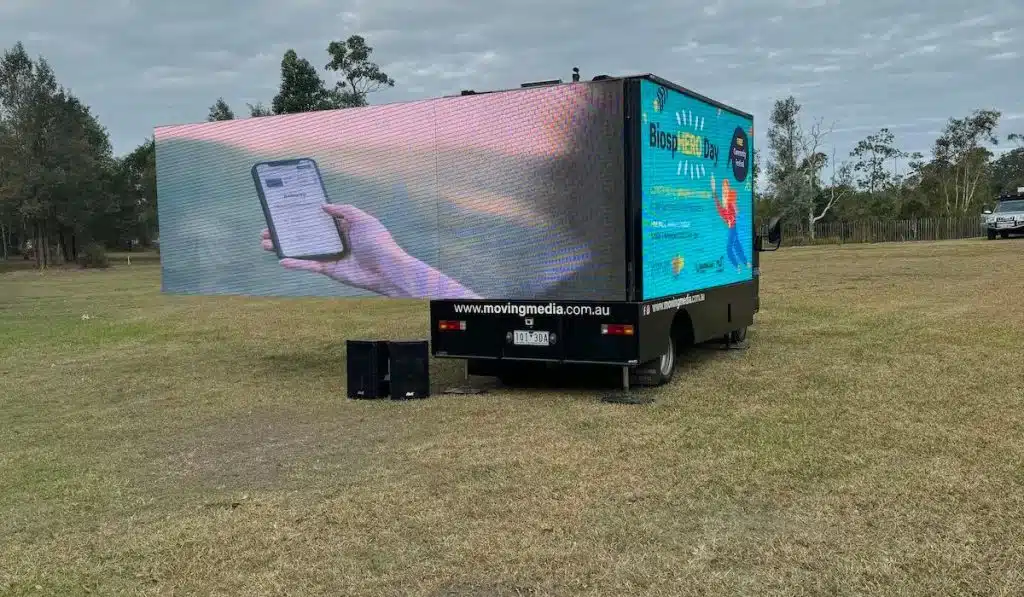
The Gold Coast doesn’t behave like a typical advertising market. Foot traffic swells and contracts by the hour. Tourist density shifts with weather, events, school holidays, and nightlife patterns. Static placements struggle to keep pace. That reality is precisely why digital trucks have become one of the most effective formats for brands activating here.
At Moving Media, we deploy LED billboard trucks across the Gold Coast to match real movement, not fixed assumptions. This post breaks down how Digital Billboard Advertising in Gold Coast environments actually performs when campaigns run in high-traffic locations rather than waiting for audiences to pass by.
Why the Gold Coast Rewards Mobile Advertising
The Gold Coast is one of Australia’s fastest-moving visitor economies. In the year ending June 2025, the region welcomed 636,000 international visitors who spent $1.5 billion, while domestic travellers added $3.7 billion in just six months. Average spend per visitor rose 30% year-on-year, and international stays extended to 14.5 nights.
This creates repeated exposure opportunities across the same corridors, precincts, and venues. An LED video truck for advertising doesn’t rely on a single fixed intersection to work. It follows the density.
That mobility matters when:
- Visitors move between beaches, shopping centres, and nightlife zones daily
- Events compress massive crowds into short time windows
- Retail demand spikes around weekends and evenings
- Tourist attention remains visual, social, and camera-ready
Digital trucks thrive in these conditions because they operate inside movement, not beside it.
Performance vs Static Outdoor Billboards on the Gold Coast
Traditional outdoor billboard placements still exist across the region, but their performance gap continues to widen.
Across Queensland and coastal markets like the Gold Coast:
- Digital trucks achieve ~80% recall, compared to 55% for static billboards
- Mobile digital formats generate 81% more attention
- Average reported ROI reaches 497% for mobile DOOH activations
- Engagement consistently outperforms fixed panels in tourism zones
Static billboards can’t relocate when crowds shift from beachfront to dining precincts. An LED display truck can. This difference becomes even more pronounced during peak tourism periods, where one kilometre can separate low-value traffic from premium audience density.
How Digital Trucks Perform by Gold Coast Location Type
Beachfront & Coastal Boulevards
Beachfront roads remain some of the most valuable advertising corridors on the Gold Coast. Pedestrians move slowly, traffic queues during peak hours, and dwell times remain high.
Digital trucks perform strongly here because:
- Vehicles and pedestrians experience repeated exposure
- Visual content benefits from open sightlines
- Audio-enabled campaigns remain effective during congestion
- Creative becomes part of the beachfront atmosphere
An LED billboard truck positioned along Gold Coast generates an impression density that static signs struggle to maintain across changing crowd flows.
Retail & Shopping Precincts
Shopping centres and surrounding arterials offer consistent footfall, but attention fluctuates throughout the day. Digital trucks adapt to these patterns.
Our campaigns are often scheduled:
- Lunchtime circuits for workers and shoppers
- Late-afternoon loops for after-work traffic
- Weekend rotations around retail hubs
This flexibility allows Digital Billboard Advertising in Gold Coast retail zones to reach audiences during actual purchase windows, not just commute hours. When paired with retargeting, combined OOH and mobile campaigns can lift store visitation by up to 127%, creating compounding visibility rather than single-touch exposure.
Transit Hubs & Arterial Routes
The Gold Coast’s transport network funnels visitors through predictable bottlenecks. Light rail stations, arterial roads, and airport-adjacent routes offer high-frequency exposure.
Digital trucks excel here because:
- Stop-start traffic increases dwell time
- GPS-based routing aligns with congestion patterns
- Creative remains visible across multiple signal cycles
Unlike fixed signage, an LED video truck for advertising can rotate between transport corridors as congestion shifts throughout the day.
Event Zones & Entertainment Precincts
Events are where mobile DOOH truly separates itself from other formats. Festivals, sporting events, surf competitions, and nightlife precincts attract large crowds for short periods. Static billboards often sit outside the core action. Digital trucks sit inside it.
Performance advantages include:
- On-site presence during peak attendance
- Audio-visual content tailored to live environments
- Ability to reposition as crowds migrate
- Integration with social content capture
Event-based deployments regularly produce some of the highest engagement and recall rates across our campaigns.
Measurement That Matches the Movement
One of the most significant barriers to DOOH investment remains the lack of attribution. Roughly 36% of Australian agencies still cite uncertainty around cost versus benefit. That gap closes quickly when campaigns use real data.
At Moving Media, we rely on Mobilytics to measure:
- Verified impressions via device detection
- Density and dwell time by location
- Peak exposure windows
- Movement patterns across routes
Our dashboard updates in real time, and post-campaign reporting includes satellite mapping, busiest locations, and retargeting-ready datasets. This level of transparency is one reason 81% of agencies now plan OOH, DOOH, and programmatic DOOH together, with 68% aligning mobile DOOH with digital video strategies.
Why Digital Trucks Outperform Static Billboards on the Gold Coast
The Gold Coast isn’t static. Neither is its audience. Digital trucks succeed here because they:
- Move with tourism patterns
- Scale frequency through repetition, not placement cost
- Adapt routes to weather, events, and congestion
- Deliver verified impressions instead of estimates
With Australia’s OOH revenue reaching $363.6 million in Q2 2025, up 19.36% year-on-year, and digital formats now dominating, mobile DOOH has shifted from novelty to necessity. Programmatic DOOH already represents 80% of digital screens, and mobile formats sit at the most flexible end of that spectrum.
As outlined in “What Brisbane Advertisers Need to Know About Digital Trucks“, performance improves when campaigns follow real crowd movement rather than relying on fixed visibility assumptions.
Sustainability Without Compromise
Every Moving Media campaign operates at 100% carbon neutrality, backed by our partnership with Reforest. Emissions from fuel, logistics, and operations are offset through verified tree-planting projects across Australia.
Clients can access real-time dashboards showing:
- Trees planted
- CO₂ offset
- Project locations
This matters in regions like the Gold Coast, where environmental responsibility directly influences brand perception among visitors and locals alike.
Why Brands Continue Choosing Moving Media on the Gold Coast
Our campaigns succeed because we don’t sell space. We manage movement. Brands work with us because we offer:
- Direct access to our founder, Mick Diffey
- End-to-end campaign delivery
- Real-time performance data
- Flexible asset deployment
- Proven results across tourism, retail, government, and events
If it’s mobile OOH on the Gold Coast, it’s Moving Media.
Frequently Asked Questions
How do digital trucks perform compared to static billboards on the Gold Coast?
Digital trucks consistently outperform static formats, delivering around 80% recall, higher engagement, and significantly stronger ROI. Their ability to move with crowds makes them especially effective in high-traffic areas of the Gold Coast.
Which Gold Coast areas work best for LED billboard truck campaigns in Gold Coast?
Beachfront corridors, retail areas, transportation routes, and event zones demonstrate robust performance. The best outcomes are achieved by integrating multiple high-traffic locations into a cohesive, efficient route plan.
Can Digital Billboard Advertising on the Gold Coast support short campaigns?
Digital trucks serve as an excellent option for short-term activations, events, product launches, and seasonal promotions. Their flexibility allows businesses to utilise them without long-term placement contracts, making them a practical choice for temporary marketing initiatives.
How is performance measured for LED video truck advertising?
We utilise Mobilytics to collect verified data on impressions, dwell time, density, and movement patterns. Our campaigns feature comprehensive post-campaign reports, including satellite mapping and insights ready for retargeting.
Do digital truck campaigns support retargeting?
Mobile device data gathered during exposure can be utilised for digital retargeting. This strategy enables brands to broaden their reach and enhance conversion opportunities beyond traditional physical locations.
