
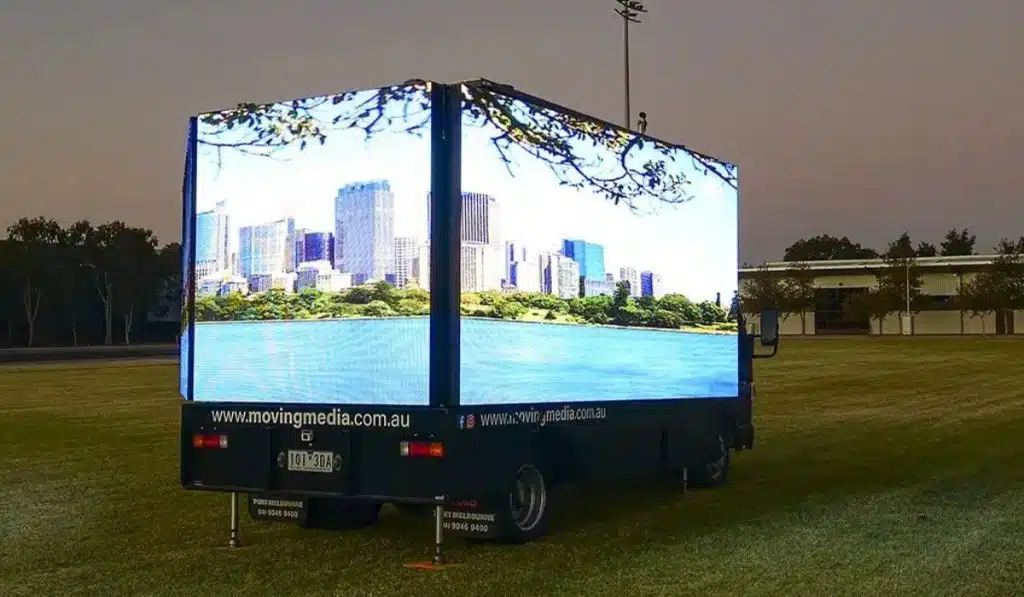
For decades, outdoor billboards have been treated as immovable anchors of city advertising, permanent, dominant, and unquestionably effective. But dense urban markets are changing. Audience movement is dynamic. Street-level attention is fragmented. And brands need visibility that adapts to shifting patterns, not one fixed point in the skyline.
This is where the long-held belief that “static always wins” begins to crack. When we analyse real Australian campaign data, the picture becomes sharper: mobility often outperforms permanence, especially in congested CBDs, high-flow commuter corridors, and activation-heavy retail zones. Independent studies now show that mobile billboards deliver 97% recall compared to 55% for static displays, along with 45% higher engagement, indicating a significant performance difference in dense environments.
At Moving Media, we’ve spent years comparing the performance of mobile billboards and fixed displays in the real world, identifying their strengths and weaknesses, and understanding where each excels. And the findings challenge industry defaults in a meaningful way.
Where Static Outdoor Billboards Hold Strong and Where They Don’t
Traditional outdoor billboards remain valuable for one reason: permanence. A towering placement on a central arterial road guarantees repeated exposure to predictable commuter traffic. They keep brands top of mind through sheer consistency.
But dense Australian markets, such as Sydney CBD, Melbourne’s inner suburbs, and Brisbane’s river corridors, introduce complications:
- High-rise shadowing reduces visibility in windows
- Pedestrian congestion shifts viewing angles unpredictably
- Shorter dwell times on busy roads dilute static impact
- Restricted placement opportunities make premium locations scarce and costly
Australian OOH data reinforces this decline in static efficiency: while the outdoor advertising market isb projected to grow from USD 1.148B in 2024 to USD 1.905B by 2033 (5.2% CAGR), 74.4% of revenue now comes from DOOH, revealing where advertisers are truly finding value.
The cost of billboard ads for centrally located static placements is often disproportionately high. Sydney sites reach $15,000–$30,000 monthly, Melbourne $12,000–$25,000, and Brisbane $8,000–$20,000, especially when the audience is mobile, distracted, or geographically inconsistent.
This is where mobility starts to pull ahead.
Follow the Audience, Don’t Wait for Them
Mobile billboards solve a core problem fixed by OOH: they go where the density actually is, not where planners hope it will be. At Moving Media, mobility isn’t an aesthetic choice. It’s an effective mechanic. Our trucks move through high-performing zones when the audience is at its peak, not when the media plan was approved.
This agility matters because:
- CBD foot traffic is time-dependent, not location-dependent
- Major road networks experience unpredictable flow bursts
- Weather shifts consumer movement patterns hourly
- Retail precincts perform in heatmap pockets, not long strips
This approach aligns with the way modern campaigns are conducted. For instance, mobile formats can deliver CPM rates as low as $2–$6, with some Australian providers recording $0.43 per thousand impressions when factoring in real-time targeting.
Static billboards may offer CPM parity on paper ($2–$5 domestically, $3–$6 internationally) but lack the flexibility that turns impressions into meaningful exposure. With mobile billboards, campaigns breathe with the city. Static sites, by contrast, wait for the city to come to them.
When Mobile Billboards Outperform Fixed Displays
Dense markets favour any format that adapts quickly, and our campaign analytics prove it. Through Mobilytics, our real-time measurement platform, we see audience behaviour as it happens, not months later. This difference often determines why mobile formats outperform fixed panels:
- Sydney CBD lunch-time density spikes can double impressions within 90 minutes
- Melbourne weekend retail corridors shift 3–4 blocks, depending on events
- Brisbane stadium precincts produce high-impact bursts before and after matches
And unlike static placements, mobile billboards move into the spike, not days too late.
At Moving Media, our data consistently shows campaigns achieving:
- Up to 650,000 impressions per activation
- Over 21,000 km of targeted route coverage
- High-frequency exposure in compressed, competitive areas
These aren’t theoretical benchmarks. They’re measured, verified outcomes the kind dense markets demand.
Mobility Rewrites Cost Efficiency
Many assume mobile billboards carry higher operational expenses. In reality, they are among the most efficient formats when evaluating audience quality, not just CPM.
Here’s how billboard ad costs shift in favour of mobility:
- Static billboards charge for location prestige even when the audience isn’t there
- Mobile billboards charge for a real audience opportunity, tracked in real time
- CPM reduces significantly because impressions concentrate in active zones
- Brands only pay for visibility where attention is actually happening
Mobile billboard trucks in major Australian markets start at $1,000–$1,800 per day, making them far more accessible than static placements, which require long-term contracts and heavy setup fees.
Measurement That Static Advertising Can’t Match
Traditional outdoor billboards offer estimated impressions based on traffic counts and historical modelling. Mobile OOH provides verified, dynamic, minute-by-minute measurement.
Through our Mobilytics integration, we can:
- Identify every device with the opportunity to view the screens
- Capture dwell times, density clusters, and behavioural movement
- Retarget impressions for extended digital impact
- Provide precise route heatmaps and peak audience times
Studies support the impact of this precision: 76% of viewers take action after seeing digital mobile billboard ads, and 61% engage via mobile devices scanning QR codes, visiting websites, or seeking location details. Static billboards cannot generate or track the same level of engagement as digital billboards.
We don’t gatekeep. Clients receive comprehensive post-campaign reports, including unique impressions, real-time paths, engagement windows, and satellite mapping. Static operators cannot match this granularity.
When Mobile Billboards Win and Why
Based on thousands of Australian campaigns, mobility outperforms static displays in situations where:
- Audience clusters are unpredictable or event-driven
- The brand wants dominance across multiple micro-locations
- Targeting requires geo-behavioural accuracy
- Short lead times demand immediate visibility
- Cost efficiency matters more than location prestige
Real-world performance aligns with the research: in one logistics campaign, five mobile billboards generated 24.6 million impressions over 14 weeks, boosting online click-through rates by 86% and driving clear behavioural outcomes.
Another study reported that 96% of surveyed viewers rated mobile advertising as more effective than static advertising. Outdoor billboards still have a role, but mobility is winning the “dense urban battle” because modern cities aren’t linear, predictable, or slow anymore. Audiences move fast. Mobility moves with them.
Mobile OOH With Strategy Built In
At Moving Media, we’ve evolved mobile advertising beyond simple truck routes. Our model blends:
- 25+ years of marketing and advertising experience
- Mobile-first creative strategy
- Australia-wide coverage (and international reach)
- Founder-led service with no middlemen
- Carbon-neutral operations through Reforest
- Real-time performance measurement through Mobilytics
This is why leading brands from Uber Eats to Victoria Police, Budget Direct, Cricks Motor Group, and nationwide universities trust us to deliver visibility where it actually matters.
Is the Market Still Built for Static?
Static billboards are not obsolete. But dense urban markets favour formats that think, react, adjust, and optimise. Permanence is no longer a guarantee of performance. The brands winning in Australia’s busiest cities aren’t choosing between static and mobile.
They’re choosing outcome over assumption, flexibility over tradition, and data-led movement over fixed presence. And the numbers, including recall rates, engagement metrics, CPM efficiency, and impression density, make the case unmistakably.
In Dense Markets, Mobility Isn’t an Alternative, It’s an Advantage
When the city becomes too fast, too dynamic, and too fragmented for static placements to keep up, mobile billboards step into their strength. At Moving Media, we don’t claim mobile always wins. However, in dense urban markets across Australia, the data, movement patterns, and measured results reveal a clearer truth.
Where people move, mobile OOH delivers.
And dense markets move constantly.
Frequently Asked Questions
Do mobile billboards actually outperform static billboards in dense cities?
Yes. Independent studies show that mobile billboards achieve a 97% recall rate, compared to 55% for static billboards, and deliver 45% higher engagement in high-density urban environments. Mobility allows campaigns to follow real audience clusters rather than relying on fixed traffic patterns, making them more effective in CBDs, retail hubs, and event-driven zones.
Are mobile billboard campaigns more cost-effective than static outdoor billboards?
Often, yes. Mobile billboard CPM rates in Australia can drop as low as $2–$6, with some campaigns achieving $0.43 per thousand impressions due to repeated daily exposures and real-time targeting. In contrast, premium static sites in Sydney and Melbourne range from $12,000 to $30,000 per month, regardless of fluctuations in audience size.
How is performance measured for mobile billboard campaigns?
Mobile OOH offers real-time, verified measurement via GPS-based analytics platforms such as Mobilytics. Advertisers receive reporting that includes unique impressions, dwell times, heatmaps, peak engagement windows, and actual device-level opportunities-to-see, far more precise than estimates generated by static billboard traffic models.
What types of brands benefit most from mobile billboard trucks?
Mobile formats are ideal for brands targeting dense, unpredictable, or fast-moving audiences, such as food delivery services, events, retail, government messaging, universities, and national campaigns that require hyper-local dominance. They also benefit SMBs who need flexible scheduling, short-term bursts, and high recall without long-term static rental commitments.
Can mobile billboards support call-to-action campaigns and digital engagement?
Absolutely. Mobile billboards consistently outperform static CTA results: 76% of viewers take action after seeing digital mobile ads, and 61% engage via mobile devices by scanning QR codes, visiting websites, or searching for location info. This makes them ideal for conversions, store openings, app installs, and geo-targeted promotions..
